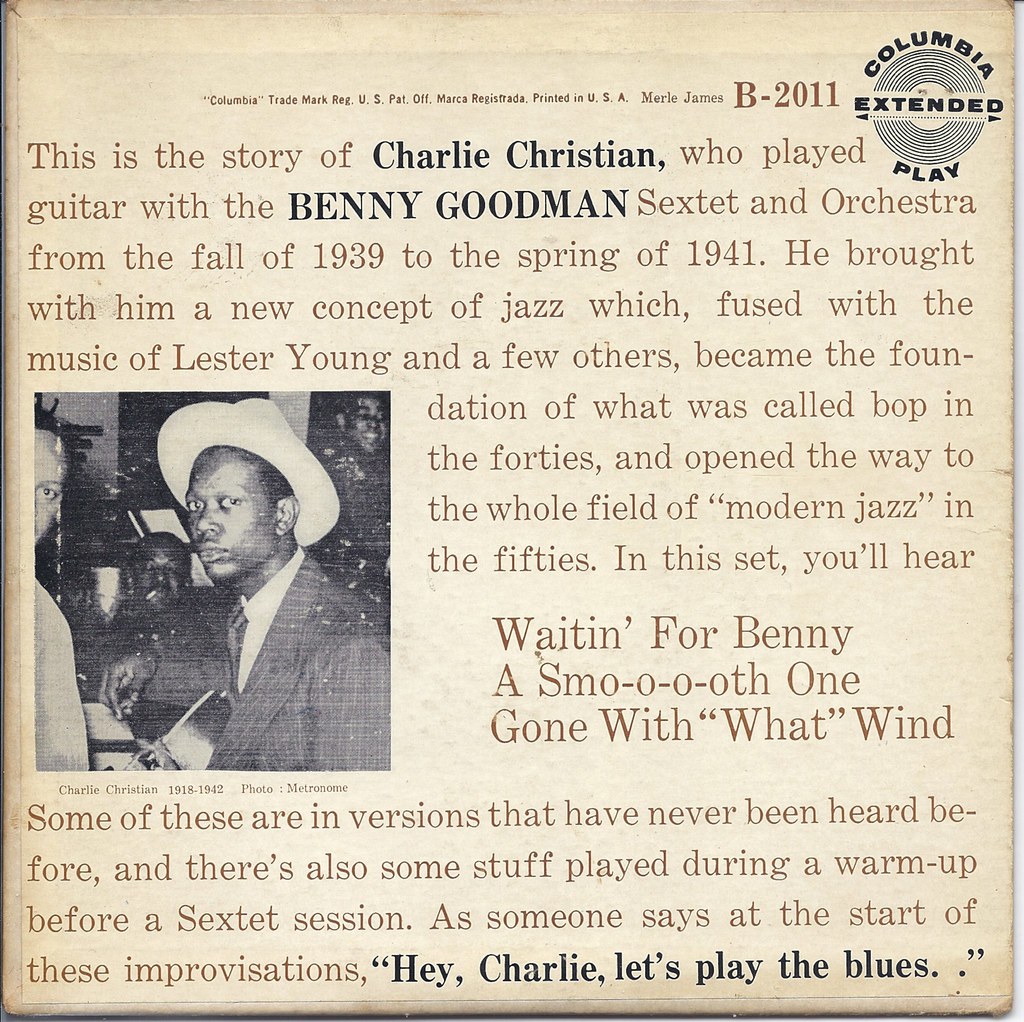
Welcome back to Guitardoor.com, where we pay tribute to the foundational pillars of the guitar—the players who didn’t just master the instrument, but completely invented its language. Today, we go back to the very beginning of the electric guitar as a solo voice to celebrate the single most important and revolutionary figure in its history: the legendary Charlie Christian. In a tragically brief but brilliant career that lasted less than two years in the national spotlight, Christian single-handedly transformed the guitar from a quiet rhythm keeper into a powerful, dynamic, and horn-like lead instrument, laying the groundwork for virtually every electric guitarist who followed.
The Birth of the Soloist
Before Charlie Christian, the guitar in a jazz ensemble was almost exclusively a rhythm instrument, its quiet chords buried in the rhythm section. Christian changed everything. Inspired not by other guitarists but by the fluid, swinging, and harmonically sophisticated phrasing of tenor saxophonists like Lester Young, he developed a completely new way of playing. He played long, flowing, single-note solos that “swung” with the power and grace of a horn. This was not just new; it was a revolution.
Beyond his groundbreaking work with the Benny Goodman Sextet, which brought him international fame, Christian was also a crucial, often overlooked, pioneer of bebop. His legendary after-hours jam sessions at Minton’s Playhouse in Harlem, alongside fellow innovators like Dizzy Gillespie and Thelon Monk, were the incubators where the new, complex, and modern language of jazz was forged. He was a harmonic visionary, using arpeggios and sophisticated passing tones to navigate chord changes in a way no guitarist had ever done before.
The Anatomy of a Revolution: Technique and Tone
Charlie Christian’s revolutionary sound was the product of his innovative technique and his pioneering use of new technology. He often employed an all-downstroke picking style for his solos, which gave his lines a powerful, consistent, and driving attack that helped him project and swing like the horn players he idolized.
His gear is the stuff of legend and is absolutely central to his story. He is famously associated with the Gibson ES-150, one of the very first commercially successful electric archtop guitars. The “secret weapon” of this guitar was its pickup, a large, single-coil unit featuring a single bar or “blade” magnet. This pickup, now universally known as the “Charlie Christian pickup,” was responsible for the first great electric guitar tone. It produced a sound that was warm, round, and clear, but with a percussive attack and a beautiful, singing sustain that allowed his single notes to soar over the band.
He typically plugged this guitar into a matching Gibson EH-150 amplifier. This small, 15-watt tube amp, when pushed, would produce a warm, slightly overdriven tone that was a revelation at the time. This combination of guitar and amplifier was the first perfect marriage of technology and artistry, creating a voice for the guitar that was loud, dynamic, and expressive enough to stand shoulder-to-shoulder with the trumpets and saxophones of the swing era.
Essential Christian: The First Electric Guitar Anthems
Charlie Christian’s recordings with Benny Goodman are the foundational texts of electric guitar. To understand his revolutionary impact, these recordings are absolutely essential.
“Rose Room” (with the Benny Goodman Sextet)
This is the shot heard ’round the world. From his very first notes on his debut recording with Goodman, Christian’s solo is a revelation. His fluid, horn-like phrasing, advanced harmonic sense, and confident swing were unlike any guitar playing that had come before, reportedly stunning his bandmates and instantly changing the perception of the instrument.
“Solo Flight” (with the Benny Goodman Orchestra)
This is the first true “hit” for a solo electric guitarist, a feature piece specifically written to showcase his incredible talent. It’s a tour-de-force of his technique, his swinging melodic lines, and his sophisticated improvisational ideas, proving that the electric guitar could be a powerful and compelling lead instrument in front of a full orchestra.
“Swing to Bop” (from the Minton’s Playhouse sessions)
Recorded informally at the legendary Harlem after-hours club, this track captures the raw, experimental energy of Christian in his element. Here, you can hear him stretching out, pushing the boundaries of swing, and trading ideas with the future giants of bebop. It’s a priceless document of a musical revolution in the making.
Charlie Christian is the “big bang” of the electric guitar. His influence is so profound and so foundational that it’s almost impossible to overstate. Every electric guitarist who followed, from B.B. King and T-Bone Walker to Wes Montgomery and Chuck Berry, owes a direct and massive debt to the language he created. In less than two years, and before his tragic death at the age of 25, he wrote the entire first chapter in the story of the electric guitar, a chapter that every player since has been reading from.
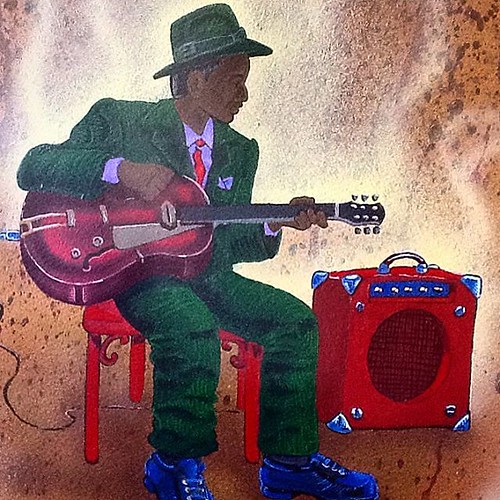
Cover Photo Credit “Charlie Christian #guitarhero #happybirthday #centenary #paint” by Paulo Chagas is licensed under CC BY-NC-ND 2.0