When guitarists talk about raw, terrifying technical ability, all roads eventually lead to Shawn Lane. Long before he became a cult icon among virtuosos, Lane was a teenage prodigy who joined Black Oak Arkansas at just 14 years old, blowing away seasoned touring musicians with blinding speed. Yet, to categorize him merely as a “shredder” misses the point entirely. Lane didn’t just play fast; he processed music at a velocity that felt entirely alien, marrying a flawless physical technique with a deep, encyclopedic mastery of harmony.
The Guitar Work: Beyond Fusion
Shawn Lane’s musical style is best described as a hyper-advanced form of fusion, but even that label feels insufficient. His guitar work was a seamless synthesis of high-gain rock power, the improvisational freedom of jazz, the soul of the blues, and the complex rhythmic structures of Southern Indian Carnatic music. He was a true innovator who saw no boundaries between genres, only new avenues for expression.
His compositions were incredibly complex, yet they always maintained a deeply soulful, melodic core. His playing has often been compared to saxophonist John Coltrane’s famous “sheets of sound”—a torrent of notes so fluid that they created a unique emotional texture. Listening to Lane means hearing a mind and a pair of hands operating at a level of fluency that few human beings have ever achieved.
The Anatomy of a Phenomenon: Technique and Tone
Shawn Lane possessed a level of command that permanently expanded the known limits of what is physically possible on a revolutionary guitar technique. His legendary speed was built on three perfectly integrated pillars:
Flawless Alternate Picking: His picking was astonishingly clean and precise. Even at blistering tempos, every single note was perfectly articulated with absolute clarity.
Liquid Legato: His fretting-hand legato technique was exceptionally fluid, allowing him to transition from picked passages to smooth, flowing lines without losing a shred of momentum.
Hybrid Picking & Wide-Interval Leaps: By mastering the combination of a flatpick and his fingers, Lane could execute massive, seemingly impossible interval leaps across the neck. This technique became the definitive signature of his unique phrasing.
Harmonic Mastery: Crucially, Lane’s brain was as fast as his hands. He possessed a profound understanding of music theory, allowing him to navigate complex chord changes and create sophisticated melodic lines on the fly.
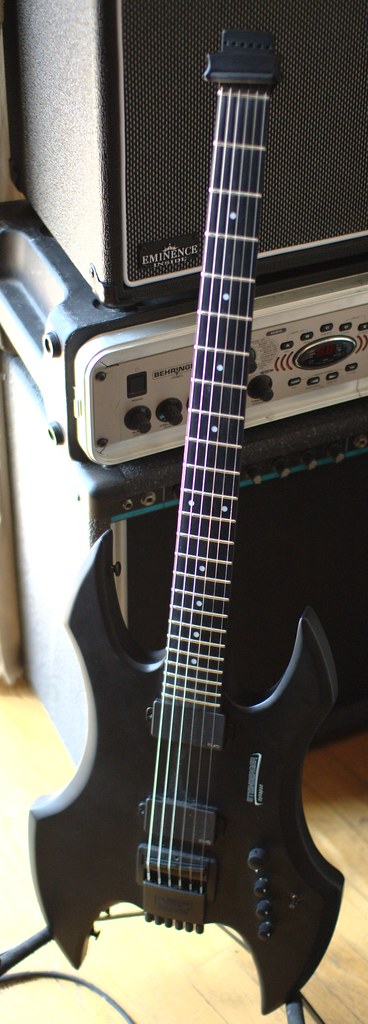
His gear choices reflected this need for absolute precision. During his early instructional video era, he heavily favored custom Charvel models. Later on, he became synonymous with headless Steinberger guitars, preferring their fast necks and rock-solid tuning stability. To make his “sheets of sound” fully audible, Lane favored a smooth, vocal-like, high-gain lead tone rather than a raw, gritty distortion. He famously achieved this with a surprisingly straightforward rig, plugging a distortion pedal into a solid-state Holmes Mississippi Blues King amplifier to get the exact clarity and singing sustain he required.
Essential Lane: A Showcase of Virtuosity
To begin to comprehend his phenomenal talent, these three pieces are a necessary deep dive and essential listening.
“Powers of Ten”
Released in 1992, Shawn Lane’s debut solo album, Powers of Ten, is a watershed moment in instrumental music. Unlike standard guitar-hero records of the era, Lane performed almost every instrument himself—including the highly complex piano tracks. The album seamlessly blends intricate, high-speed guitar tracks like “Get You Back” with classical compositions and sophisticated jazz voicings. Despite its early-90s digital production, it remains a definitive masterclass in odd rhythmic groupings and boundary-pushing virtuosity.
“Gray Pianos Flying”
“Gray Pianos Flying” is one of the shortest but most intense tracks on Powers of Ten. It serves as a concentrated, relentless showcase of Lane’s unrivaled speed and complex phrasing outside of a traditional jazz-fusion structure. Built on a melancholic, slightly cinematic keyboard foundation, the song highlights his ability to turn a staggering number of notes into an uplifted, almost surreal emotional experience.
“Temporal Analogues of Paradise”
For many, Lane’s absolute peak was his improvisational trio work with virtuoso bassist Jonas Hellborg and master drummer Jeff Sipe. Temporal Analogues of Paradise (1996) is a live masterwork consisting of long, completely improvised movements. Here, away from studio constraints, Lane’s playing reaches an almost spiritual level. He shifts effortlessly from beautiful, ambient chordal textures to jaw-dropping, high-velocity fusion runs that leave audiences entirely stunned.
Shawn Lane remains a figure of immense and profound influence within the virtuoso guitar community. He is the ultimate benchmark for technical excellence—the player that other world-class players speak of with a unique sense of awe. Though he is no longer with us, his recordings remain as a testament to his genius, forever documenting a musician who didn’t just play the guitar, but transcended it, expanding its language and inspiring all who followed to reach for the impossible.
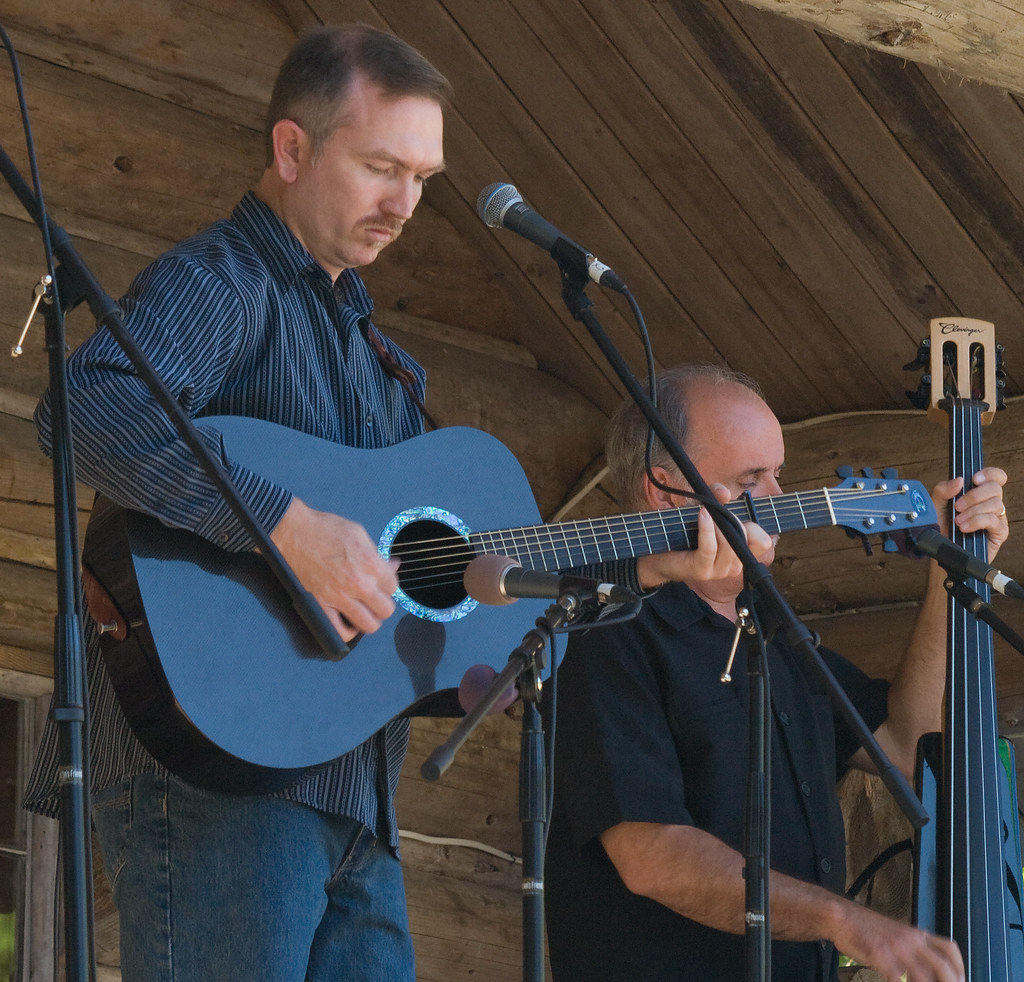
Cover Photo Credit “Shawn Lane” by armadilo60 is licensed under CC BY-SA 2.0