
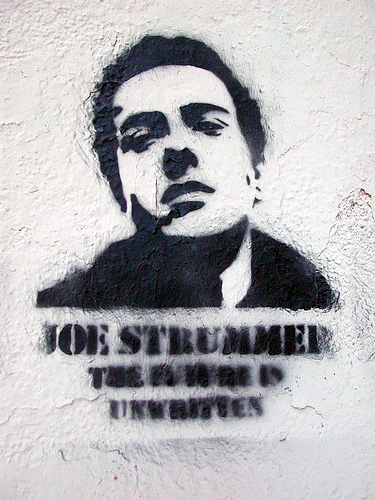
Joe Strummer (1952–2002), born John Graham Mellor, was the fiery frontman, primary lyricist, and rhythm guitarist for The Clash, the band widely regarded as “The Only Band That Matters.” Strummer was more than just a musician; he was the political and intellectual conscience of punk rock, blending ferocious three-chord attack with sophisticated, politically charged lyrics that covered themes of social injustice, anti-establishment anger, and global conflict. His vision broadened The Clash’s sound far beyond punk’s original limits, seamlessly incorporating elements of reggae, rockabilly, dub, and jazz, ultimately forging a legacy that remains a benchmark for socially conscious rock music.
🎸 The Strummer Technique: Rhythmic Aggression and Attitude
Joe Strummer’s guitar playing was entirely dedicated to rhythm and urgency, serving as the driving, chaotic motor of The Clash. His style prioritized raw energy and rhythmic attack over melodic sophistication.
The Machine-Gun Strum: Strummer’s signature technique was the relentless, heavy-handed downstroke strum, often played at high speed and with minimal chord changes. This technique produced a loud, percussive chug that defined the aggressive, no-frills sound of classic punk. His goal was to create sonic urgency, making the guitar feel less like an instrument and more like a loud, rhythmic weapon.
Tone and Gear: He famously used a well-worn Fender Telecaster (often painted with military green and stenciled with phrases), which was key to his sharp, mid-range, and cutting tone. He generally avoided complex effects, relying on the natural distortion and volume of his amplifier (often a Marshall) to deliver a primal, articulate roar that cut through the band’s frantic pace.
The Rhythmic Anchor: Within The Clash’s twin-guitar attack (alongside Mick Jones), Strummer’s role was always the foundation. He played simple, powerful barre chords with immense rhythmic focus, acting as the bedrock that allowed Jones the space for more melodic lead and riff-based playing.
🎶 Three Essential Tracks and Their Rhythmic Approach
Three songs showcase the breadth and defining rhythmic power of Joe Strummer’s guitar style:
“London Calling” (1979)
This iconic song demonstrates Strummer’s successful fusion of punk urgency with reggae and rockabilly grooves. His guitar part requires a choppy, disciplined strum that locks into the driving bass and drum rhythm, providing the essential rhythmic pulse. The player must focus on maintaining a constant, slightly swinging feel in the barre chords during the verses and exploding into full-bodied power during the chorus, providing the necessary dynamic shifts for the song’s apocalyptic sweep.
“Know Your Rights” (1982)
A ferocious, high-speed track from Combat Rock, this song perfectly illustrates the machine-gun strum at its most intense. The approach requires unrelenting commitment to the downstroke, driving the basic three-chord progression with blistering speed and aggression. The player should concentrate on playing the chords with maximum attack and minimal sustain, letting the rhythmic snap of the strings dominate the texture to achieve the track’s urgent, confrontational sound.
“Jail Guitar Doors” (1978)
This song is a pivotal track for The Clash, particularly resonant with the philosophy of our band, Guitardoor, as its title embodies the idea of music as a vehicle for truth and rebellion. Strummer’s guitar work here is a masterclass in rock-and-roll simplicity and swagger. The main riff uses a classic Chuck Berry-style feel played with a loose, slightly distorted swagger. The guitarist must focus on creating a swinging, blues-derived rhythmic groove that drives the narrative forward, showcasing how Strummer used traditional rock-and-roll phrasing and power chords to deliver punk’s revolutionary message.
🎉 Conclusion Wrap-up: The Riff and the Revolution
Joe Strummer’s legacy is defined by his profound belief that music could be a direct catalyst for social and political change. As a guitarist, he was a revolutionary who rejected technical excess in favor of raw, driving rhythmic power. His machine-gun strum and commitment to a simple, aggressive, blues-rooted attack provided the necessary fuel for The Clash’s genre-defying sound. Strummer proved that the most powerful instrument is not the one with the most notes, but the one that rings with the most conviction, forever establishing him as the indispensable voice of rock’s social conscience.
Cover Photo Credit “Joe Strummer stencil [Lyon, France]” by biphop is licensed under CC BY-NC-SA 2.0