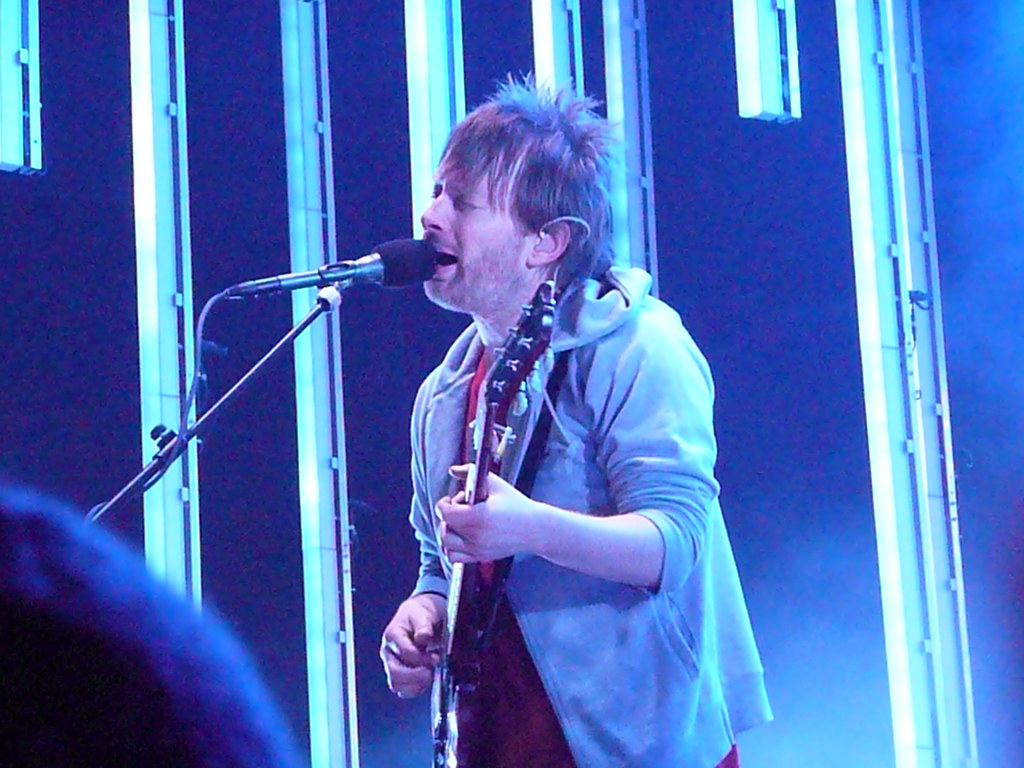
Welcome back to Guitardoor.com, where we celebrate musicians who use the guitar to serve a larger artistic vision. Today, we turn our attention to the creative force and visionary leader of Radiohead, Thom Yorke. While his iconic voice and introspective lyrics anchor the band, his role as a guitarist—particularly as the primary rhythm guitarist and musical conceptualist—is crucial, often acting as the melodic and harmonic anchor against Jonny Greenwood’s sonic experimentation. Yorke’s playing is defined by his unconventional chord voicings, use of arpeggiation, and deliberate simplicity, making him a foundational rhythm player unlike any other in rock.
The Sound of Melancholy and Structure
Thom Yorke’s guitar work evolved dramatically alongside Radiohead’s career, from the angst-ridden grunge of Pablo Honey to the sophisticated electronics of Kid A and beyond. His playing style is inextricably linked to his songwriting. He often uses the guitar to find unexpected chord shapes and inversions that create a darker, more ambiguous harmonic mood, setting the stage for his unique melodies.
The Melodic Anchor: Yorke’s parts are rarely busy. They are often simple, memorable chord structures or repetitive figures that hold the center of the song, providing the stability and melancholic tone for the other instruments to orbit.
The Unconventional Voicing: Yorke frequently avoids open chords and standard shapes, favoring complex-sounding barre chords and unique fingerings that prioritize specific intervals. This gives his rhythms a distinctive, almost jazzy or classical harmonic color that is central to the “Radiohead sound.”
Arpeggiation and Texture: On quieter tracks, he often relies on arpeggiation (playing the notes of a chord individually rather than simultaneously) to create movement and depth. This technique adds to the atmosphere, notably replacing traditional strumming on many later tracks.
Acoustic & Electric Simplicity: He often switches between his signature Fender Telecaster (used for bright, clean electric rhythms) and a simple acoustic guitar, proving that immense impact can be achieved with modest means and perfect placement.
The Harmony in the Chaos
In Radiohead, Yorke’s guitar parts work in brilliant tandem with Jonny Greenwood’s lead work. Where Greenwood provides the fire, noise, and chaos, Yorke provides the water, structure, and foundation.
The Harmonic Duo: Thom Yorke’s rhythm parts—often containing sophisticated, unusual chord progressions—provide the essential harmonic backdrop. This structure allows Jonny Greenwood the freedom to layer aggressive textures, dissonant sounds, and anti-solos without the music completely dissolving into noise.
This dynamic tension is key to the band’s longevity and unique sound. Yorke gives the listener a clear, if emotionally complex, foundation to follow.
The Essential Harmonic Signatures
Thom Yorke’s rhythm and chordal work defines the mood of these classic tracks. To understand his non-traditional approach to the instrument, these three examples are essential.
Fake Plastic Trees
This is a masterclass in acoustic atmosphere and unexpected chords. To play this, the key is the delicate, arpeggiated strumming and the gorgeous, mournful chord voicings. The fingerings are often unusual but create a profound sense of sadness and sweep. Yorke uses the acoustic guitar as a vehicle for pure, fragile emotion.
Just
This early track showcases Yorke’s ability to craft a driving, infectious electric riff that still feels slightly angular and tense. The main guitar part is a simple, high-energy rhythm that locks in with the drums, proving that he can hold down a powerful rock track with an assertive, if non-flashy, style. It’s built on strong, simple power chords played with aggressive downstrokes.
Weird Fishes / Arpeggi
A perfect example of his later, more minimalist approach. The core guitar part is a simple, intricate acoustic arpeggio that repeats hypnotically throughout the song. To approach this, precision and perfect timing are paramount. The focus is entirely on the fluid, clean picking pattern which acts as a gentle, yet compelling, rhythmic pulse for the entire track. This technique defines the sound of much of the In Rainbows era.
In the end, Thom Yorke’s legacy as a guitarist is defined not by virtuosity, but by his visionary songwriting and his ability to use the instrument as a tool for harmonic expression and mood-setting. He is the ultimate anti-guitar hero who showed that an unconventional approach to rhythm and harmony can be far more powerful and enduring than any shredding solo.
Cover Photo Credit “Thom Yorke of Radiohead” by angela n. is licensed under CC BY 2.0