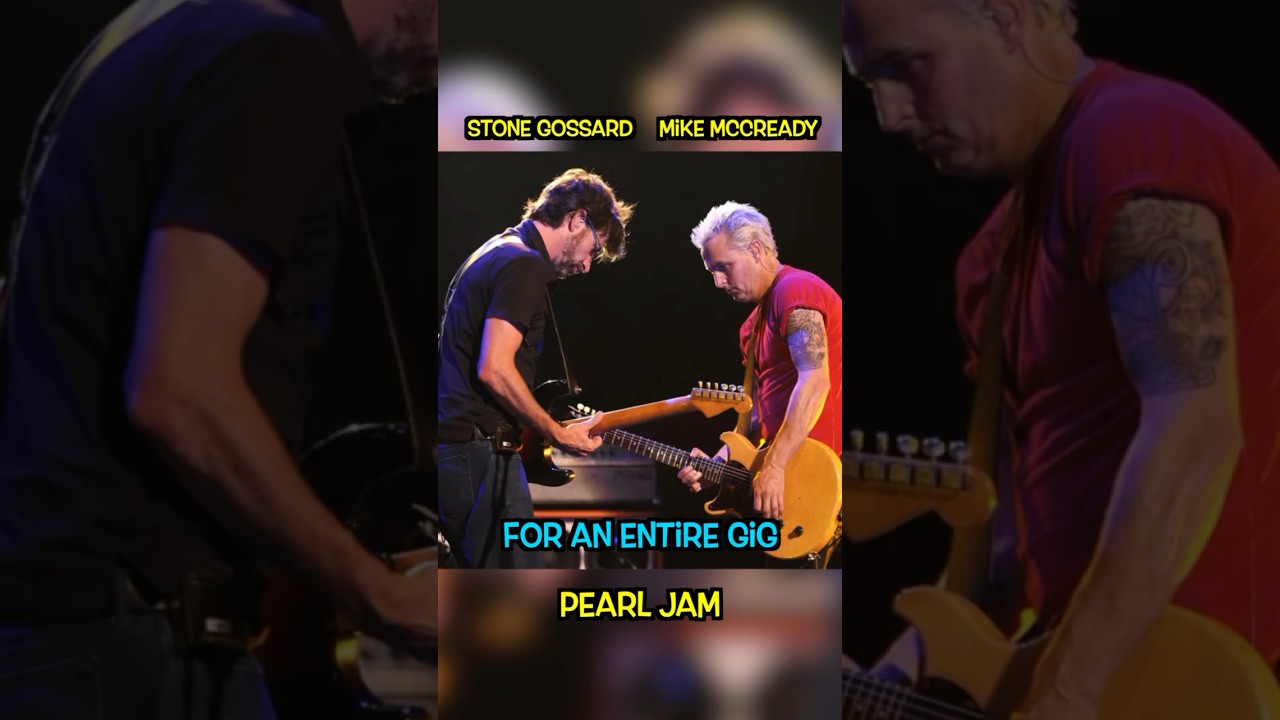
If Mike McCready is the kinetic lightning in Pearl Jam’s sound, Stone Gossard is the tectonic plate that shifts beneath him. Their relationship isn’t a simple “lead vs. rhythm” dynamic; it is a masterclass in musical architecture. While Mike—whose own legendary path is detailed in our deep dive, Mike McCready: The Soulfire of Seattle—grew up worshipping the shred-heavy blues of Stevie Ray Vaughan and the psychedelic fire of Hendrix, Stone developed a different approach. As explored in Stone Gossard: The Groove Master of Grunge, Stone was obsessing over the idiosyncratic, angular grooves of bands like Jane’s Addiction and the funk-rock fusion of Mother Love Bone.
When these two styles collided in 1990, they created a “two-headed” guitar monster that Mark Knopfler would likely recognize as a quintessential study in contrasting tone. Stone’s contribution is often about “subtraction”—finding a weird, three-note riff that leaves massive holes for the drums and bass to breathe. Mike then fills those holes with high-octane emotion. On tracks like “Even Flow,” you can hear this perfectly: Stone provides the slippery, funk-laden skeleton, while Mike adds the muscle and the howl.
The brilliance of their collaboration lies in their lack of ego. In recent years, they’ve become even more fluid, often switching roles or playing nearly identical parts to create a massive wall of sound. Stone has admitted that as he’s matured, he’s moved toward a more “meditative” style, focusing on textures and using tools like the Bigsby vibrato to make single chords “speak.” This approach isn’t unlike the precision required to master legendary riffs that define a player’s legacy.
This evolution was most evident during the transition from the stadium-rock polish of Ten to the raw, jagged experimentation of Vitalogy. While Mike was ripping some of his most legendary solos, Stone was pushing the band into uncomfortable, “weird” territory with tracks like “Pry, To” and “Bugs.” They aren’t just two guys playing guitar; they are two distinct sonic philosophies that somehow perfectly balance each other out.
One of the most revealing looks at their bond is their shared history in Temple of the Dog. This project was the bridge between their past in Mother Love Bone and their future as global icons. It was here that Mike truly “found” his voice, encouraged by Stone and Chris Cornell to let loose on tracks like “Reach Down.”
Today, whether they are playing to 40,000 people at Wrigley Field or jamming in a small studio, that fundamental “push and pull” remains. Stone builds the house, and Mike sets it on fire. It is a masterclass in chemistry that rivals the rhythmic precision of architects like Freddie Stone. Stone builds the foundation, Mike provides the color, and the result is a legacy that refuses to stagnate.
Keep Exploring the Roots of Rock
The story of these two guitarists is just one chapter in a much larger history of rock and blues innovation. If you enjoyed diving into the chemistry between Stone and Mike, I highly recommend checking out our other in-depth profiles:
- Jimmy Rogers: The Architect of Chicago Rhythm – Discover the man who built the foundation for the rhythm-heavy blues style that influenced so many grunge legends.
- Gene Clark: The Melancholy Soul of Folk-Rock – Explore the songwriting depth of one of rock’s most underrated pioneers.
- Dean Brown: The High-Octane Architect of Fusion – For fans of technical precision and complex improvisation, this is essential reading.