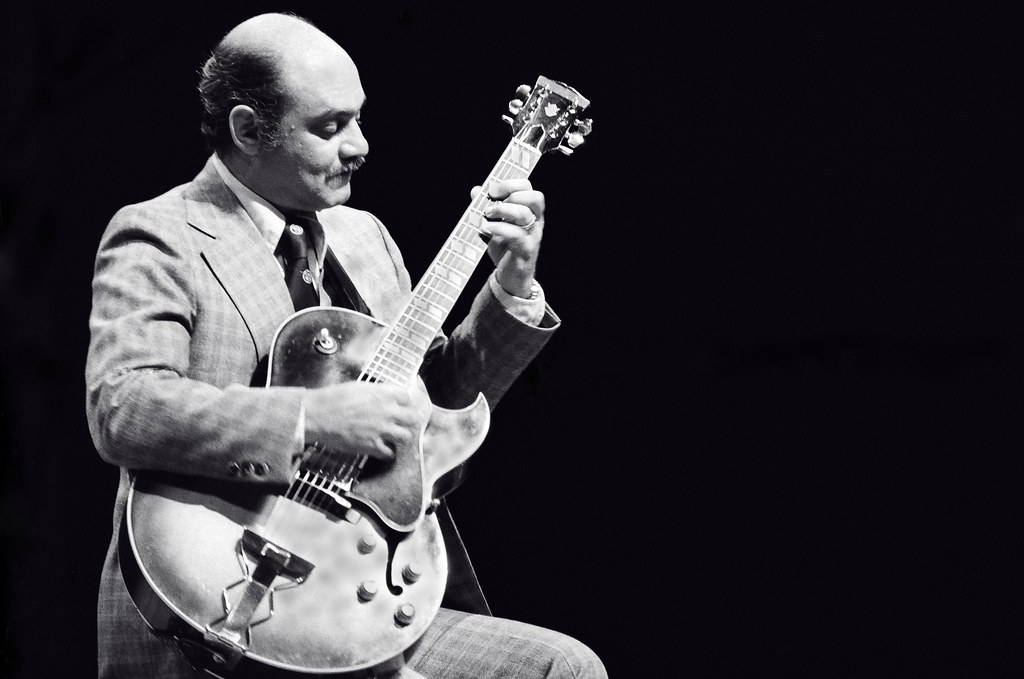
Welcome back to Guitardoor.com, where we pay tribute to the undisputed masters of the instrument. Today, we celebrate one of the most important, revered, and technically brilliant guitarists in the history of jazz: the one and only Joe Pass. A true virtuoso in every sense of the word, Pass was a master of harmony, a pioneer of solo guitar, and a complete musician who could play blazing bebop lines, lush chords, and walking basslines—often all at the same time.
The Art of the Solo Guitar
The musical style of Joe Pass was deeply rooted in the fiery, improvisational language of bebop. He possessed a phenomenal ability to “run the changes,” weaving fast, complex, and harmonically sophisticated single-note lines over any chord progression with the grace and logic of a master saxophonist like Charlie Parker.
Where he became a true revolutionary, however, was in the art of solo jazz guitar. While others had played unaccompanied, Joe Pass took it to an entirely new level, creating the sound of a full jazz trio on a single instrument. His groundbreaking chord-melody technique was a stunning display of musicianship, where he would simultaneously play a song’s melody, its underlying chords, and a walking bassline. His landmark 1973 album, Virtuoso, was a revelation, showcasing this incredible ability and setting a new standard for what was possible on the instrument.
Beyond his solo work, he was also one of the world’s greatest accompanists. His legendary duo recordings with vocalist Ella Fitzgerald are a masterclass in sensitivity, taste, and harmonic support, while his tenure with the legendary Oscar Peterson Trio showcased his incredible ability to trade fiery solos with the best in the business.
Anatomy of a Virtuoso: Technique and Tone
Joe Pass’s incredible ability to sound like a full band was the result of his complete technical command of the guitar. He primarily used a pick for his lightning-fast, single-note runs, but would seamlessly integrate his fingers to pluck chordal voicings and bass notes, a form of hybrid picking that was essential for his complex solo arrangements. His ability to maintain a steady, swinging walking bassline on the lower strings while simultaneously playing chords and melodies on top is a technique that has been studied by jazz guitarists for decades.
His choice of gear was as classic, elegant, and straightforward as his music. His most iconic and beloved instrument was the Gibson ES-175. This quintessential hollow-body archtop, with its warm, round, and woody tone, was the perfect voice for his sophisticated harmonic style. The ES-175’s rich, acoustic-like character allowed both his single-note lines and his complex chords to ring out with beautiful clarity.
To amplify this classic guitar, Pass famously favoured the Polytone Mini-Brute amplifier. This small, solid-state amp was prized by jazz musicians for its portability, reliability, and its incredibly clean, clear, and uncolored tone. It acted as a transparent canvas, allowing the pure, natural sound of his Gibson and the nuance of his incredible technique to be heard without any added effects. His rig was the definition of “less is more”—a testament to the fact that for a true master, the tone is all in the hands.
Essential Pass: A Masterclass in Jazz Guitar
The discography of Joe Pass is a foundational library for any student of jazz guitar. To understand his incredible versatility as a solo artist, an accompanist, and a small-group player, these recordings are absolutely essential.
“Cherokee”
“Cry Me a River”
“Joe Pass You Are The Sunshine Of My Life”
Joe Pass is one of the absolute giants of jazz guitar, a figure whose importance is on par with legends like Django Reinhardt and Wes Montgomery. He almost single-handedly defined the art of modern solo jazz guitar, influencing virtually every player who followed. He was a complete musician, a brilliant improviser, and a true virtuoso whose profound legacy continues to inspire and educate guitarists all over the world.
Cover Photo Credit “Joe Pass” by Tom Marcello is licensed under CC BY-SA 2.0