
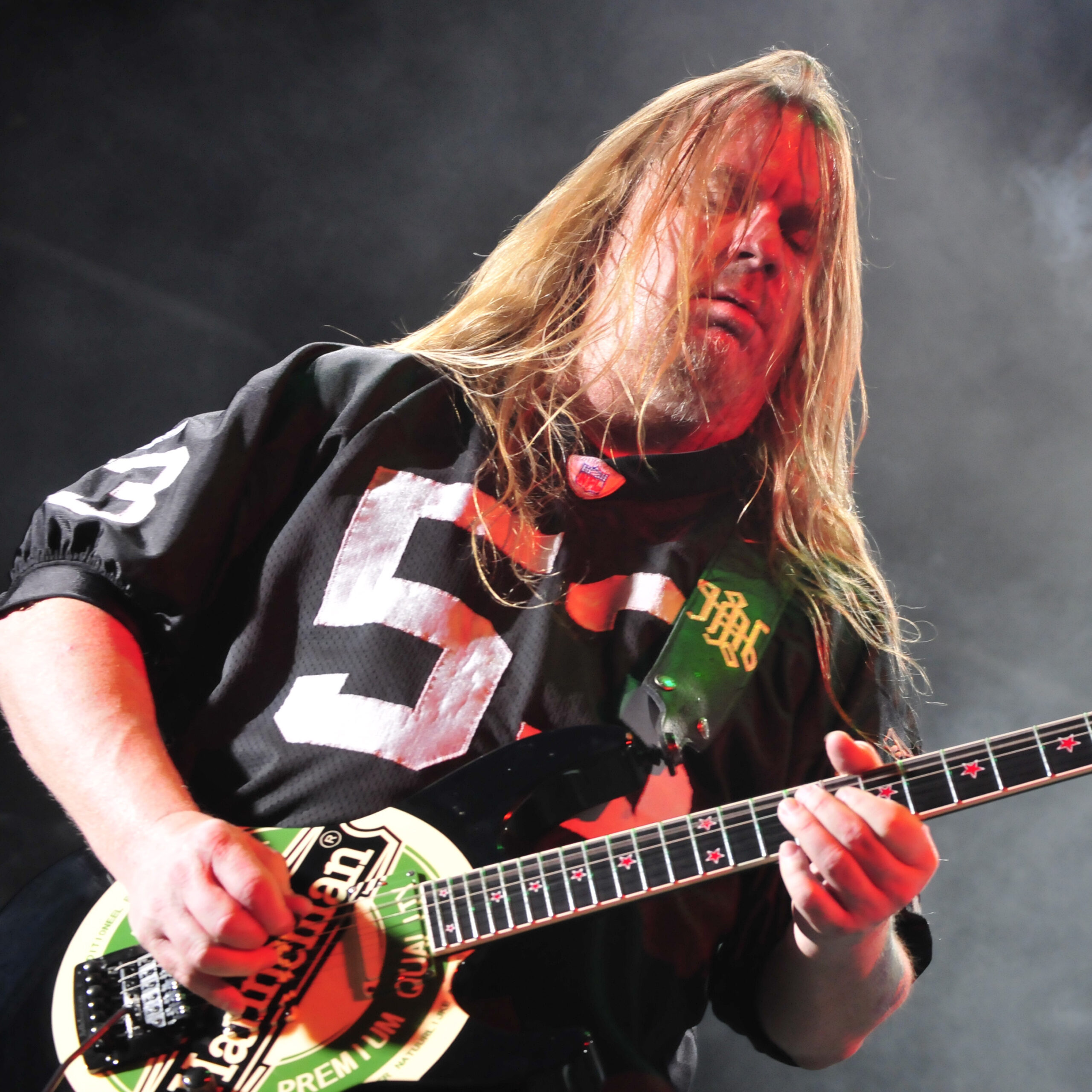
Welcome back to Guitardoor.com, where we pay tribute to the most influential and uncompromising forces in music. Today, we descend into the maelstrom to honor a true architect of extremity: the late, great Jeff Hanneman. As a founding guitarist and one of the primary songwriters for the legendary thrash metal titans, Slayer, Hanneman was a master of sonic warfare.1 His dissonant, chaotic, and terrifyingly aggressive style created a new and terrifying language for heavy metal, cementing his legacy as one of the most important and influential rhythm and lead players in the genre’s history.2
The Sound of South of Heaven
The musical style of Jeff Hanneman is the sound of pure, unadulterated aggression. His songwriting and playing were a visceral and intentional assault on the senses.3 While many of his thrash contemporaries were still rooted in the speed and melody of the New Wave of British Heavy Metal, Hanneman drew inspiration from the raw, chaotic energy of hardcore punk.4 He fused this punk ethos with metal’s power, creating riffs that were not just fast, but genuinely menacing and dissonant.5
His riffs were often built on atonal and chromatic patterns, deliberately avoiding conventional melody to create a sense of dread and unease.6 This, combined with Slayer’s trademark breakneck tempos, created a sound that was faster, heavier, and more extreme than anything that had come before it. His lead playing was a perfect extension of this philosophy. A Jeff Hanneman solo was not a structured, melodic statement; it was a violent explosion of noise, a sonic representation of chaos. His solos were shrieking, atonal torrents of notes, characterized by whammy bar abuse, frantic tremolo picking, and a complete disregard for traditional scales, perfectly capturing the horror and violence depicted in his lyrics.
The Anatomy of Aggression: Technique and Tone
Jeff Hanneman’s technique was built entirely around speed, aggression, and creating chaos. His rhythm playing was a masterclass in down-picking, delivering his complex, lightning-fast riffs with a relentless and machine-gun-like precision that gave Slayer its signature percussive power.7 His fretting hand was a blur, navigating the fretboard with a ferocity that matched the music’s intensity.
His lead style was a deliberate rejection of conventional guitar heroics. Instead of practicing scales, he perfected the art of creating pure, terrifying sound. His solos were a whirlwind of techniques: lightning-fast, often atonal tremolo picking across the higher strings, wild and unpredictable whammy bar dives and shrieks, and a raw, aggressive vibrato.8 He wasn’t trying to be a “guitar hero” in the traditional sense; he was trying to paint a picture of sonic horror.
His choice of gear was as straightforward and weaponized as his playing. For most of his career, he was famously loyal to ESP Guitars, which produced his iconic signature models, often adorned with custom graphics reflecting his interests.9 These were high-performance, “super-strat” style guitars built for one purpose: to handle the demands of extreme metal. They were almost always loaded with EMG active pickups (typically the 81/85 set), which were crucial to his sound. The high-output, compressed, and noise-free nature of EMG pickups allowed his aggressive, palm-muted riffs to remain tight, clear, and percussive, even under massive amounts of gain.
To get his signature searing tone, Hanneman relied on the classic thrash metal combination of a Marshall JCM800 head boosted by an overdrive pedal (like a Tube Screamer) in the front. This setup provided the perfect blend of British tube amp roar and the tight, focused aggression needed for Slayer’s sound. His effects were minimal, with a wah pedal used for tonal shaping in his solos being one of the few constants. His rig was a simple, brutally effective machine designed to deliver maximum sonic devastation.
Essential Hanneman: The Unholy Trinity
Jeff Hanneman’s riffs and solos are the very definition of thrash metal. To understand his monumental and terrifying contribution to music, these three tracks are absolutely essential.
“Angel of Death”
“Raining Blood”
“South of Heaven”
Jeff Hanneman was a true extremist and a musical visionary. He was an uncompromising artist who pushed the boundaries of heavy metal to their absolute breaking point and beyond. His chaotic solos and his dark, dissonant riffs created a sound that was terrifying, thrilling, and profoundly influential, cementing his legacy as one of the most important architects of extreme music ever to pick up a guitar,
Cover Photo Credit “Jeff Hanneman f9e o (square crop)” by Victoria Morse is licensed under CC BY-SA 2.0