
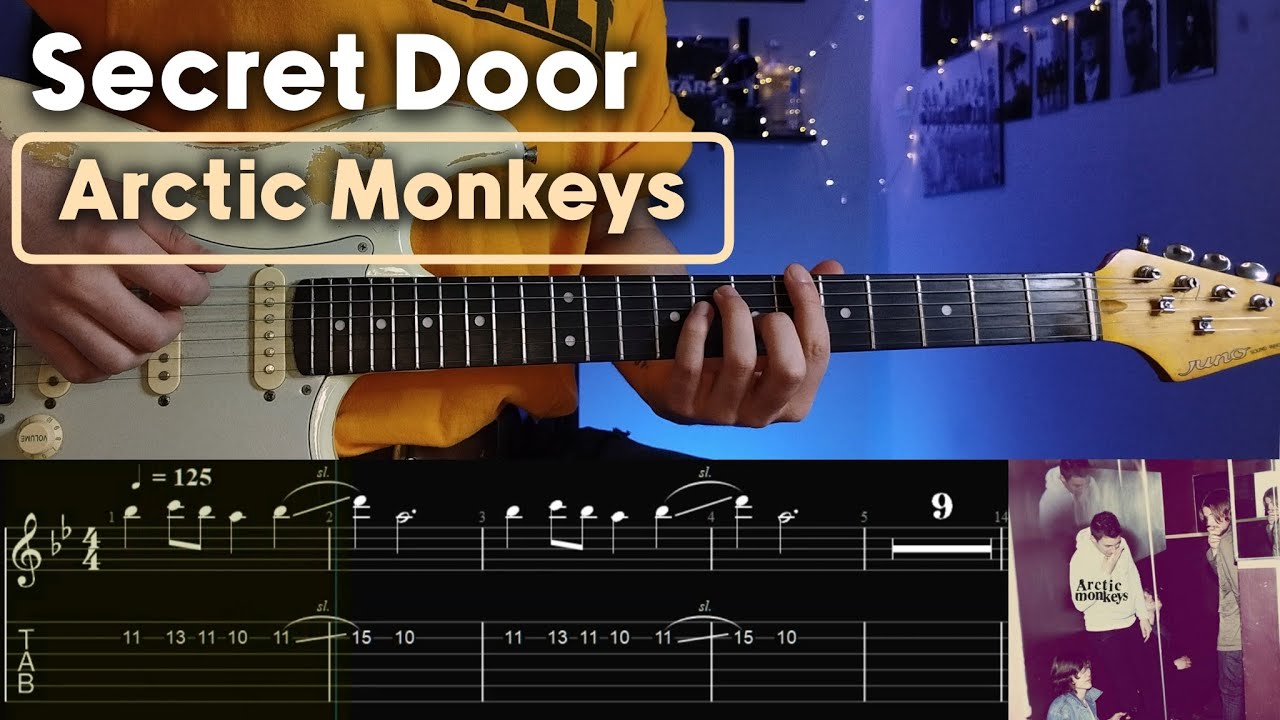
Released on their 2009 album Humbug, “Secret Door” is one of Arctic Monkeys’ most atmospheric tracks. Produced during the Humbug sessions—where bandmate Jamie Cook and Alex Turner leaned heavily into vintage textures, tape delays, and heavy reverb—the song abandons straight-ahead indie-rock strumming in favor of dynamic shifts, minor-to-major contrast, and moody arpeggiated voicings.
1. Required Chords & Tuning
Before starting, place your Capo on the 3rd Fret. All chord names, fret numbers, and tab patterns listed below are relative to the capo.
Required Chord Shapes
- G Major (
320003) – Main tonal anchor. - Gmaj7 (
320002) – Adds the dreamy, melancholic flavor to the intro motif. - Cm (
x35543) – A minor 4th barre chord that creates the song’s signature chromatic shift. - Em (
022000) – Used heavily in the verse and chorus transitions. - Bm (
x24432) – Standard 2nd-fret barre chord for movement across the minor sections. - Am (
x02210) – Simple open voicing powering the chorus resolution. - D Major (
xx0232) – Drives the end of the verse phrasing into the next section.
2. Quick Reference Chart
| Chord Name | Fret Diagram (Rel. to Capo) | Difficulty | Role in Song |
| G | 3 2 0 0 0 3 | Easy | Home Key / Main Resolution |
| Gmaj7 | 3 2 0 0 0 2 | Easy | Intro & Interlude Voice Leading |
| Cm | x 3 5 5 4 3 | Intermediate | Chromatic “Borrowed” Chord |
| Em | 0 2 2 0 0 0 | Easy | Verse & Chorus Core |
| Bm | x 2 4 4 3 2 | Intermediate | Structural Transition |
| Am | x 0 2 2 1 0 | Easy | Chorus & Outro Build |
| D | x x 0 2 3 2 | Easy | Verse Turnaround |
3. Video Tutorial & Demonstration
Watch this video tutorial to hear the exact timing, picking attack, and dual-guitar interaction played along with the original track:
Arctic Monkeys-Secret Door(Guitar tabs/lesson)
4. Step-by-Step Song Lesson
1.Master the 6/8 Strumming Pattern:Focus on keeping beat 1 heavy and beats 2-6 light.
The song is felt in a rolling $6/8$ (or $3/4$) time signature at roughly 125 BPM.
Instead of heavy down-strums on every beat, pick the root bass note of each chord on beat 1, followed by soft, syncopated upward brushes across the top three strings ($B$ and High $E$) on the remaining beats.
- Pattern:
[Bass Note] - Down - Up - Down - Up - Down - Count:
1 - 2 - 3 - 4 - 5 - 6
2.Play the Intro & Chromatic Shift:G -.
Gmaj7 -> Cm -> Em”>
Start on the G Major shape. Transition cleanly to Gmaj7 by dropping your high string note down one fret, then immediately move up to the Cm barre chord at the 3rd fret.
Pay close attention to the G to Cm movement—this minor-four shift provides the entire atmospheric tension for the track before resolving smoothly to Em.
3.Execute the Verse Movement:Em -.
Bm -> G -> D”>
The verse holds a steady 4-chord progression.
Work on smooth transitions between the open Em and the 2nd-fret Bm barre chord. Make sure your index finger anchors firmly across the 2nd fret so the $A$ string root and high treble strings ring clearly without buzzing.
4.Dial In Jamie Cook’s Tone & Lead Work:Jamie Cook’s Lead Accents & Rig Setup.
While Turner holds down the core chordal rhythm, Jamie Cook layers subtle lead arpeggios, tremolo picking, and ambient accents over the main progression.
- Guitar & Tone: During the Humbug era, Jamie relied heavily on his Gibson ES-335TD (fitted with a Bigsby) and Fender Jazzmasters running into vintage tape echo (like the Deluxe Memory Man) and tremolo.
- Playing Tip: If playing with a second guitarist, have one player stick to the low open rhythm chords while the second player voices higher triadic lead lines around Jamie’s signature style.
5.Build the Chorus & Outro Climax:Bm -.
Em -> Am -> D”>
During the chorus and final building section, double the strumming intensity. Accentuate the low bass notes on Am and D to lift the dynamics as the vocal phrasing builds toward the track’s dramatic conclusion.
5. Theory & Songwriting Insight: The Borrowed Chord Shift
For guitarists looking at composition, “Secret Door” is a prime example of using a borrowed chord from the parallel minor key.
Moving straight from a bright G Major into a Cm (the minor iv chord) creates an instant sensation of mystery and tension. This technique—frequently heard in classic 1960s pop and psychedelic rock—gives the main motif its distinct, cinematic quality.