
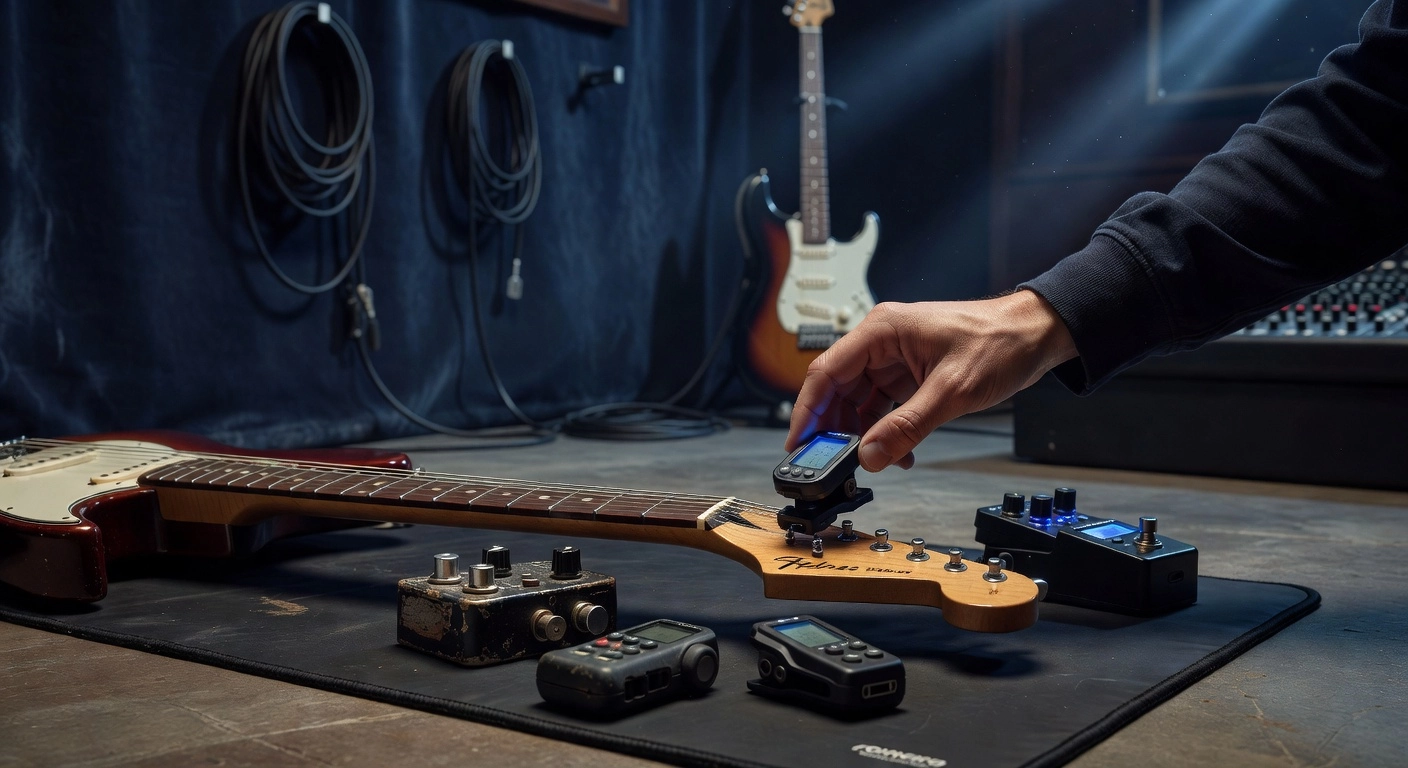
There is nothing more frustrating than strumming your first chord and realizing your guitar sounds completely off. Every guitarist has been there. The good news is that a reliable guitar tuner is one of the simplest tools you can add to your setup, and it makes a world of difference.
Whether you just unboxed your first instrument or you have been playing for a few months, getting in tune is the first step to actually sounding good. Walk into any music store or browse online, and you will find a dozen different types of tuners staring back at you. Clip-ons, pedal tuners, phone apps… it can feel a little overwhelming when you are just starting out.
That is exactly why we put this list together. We have rounded up the guitar tuners that real players actually reach for, with options that work perfectly for beginners. By the end of this post, you will know exactly what to look for, what to avoid, and which tuner might be the best fit for your specific setup.
Three Types of Guitar Tuners Worth Knowing
Before you compare prices or read a single spec sheet, it helps to know that there are really just three kinds of guitar tuners most players actually use. Each one fits a different moment in your week, and once you see that, the whole decision gets a lot simpler.
Clip-on tuners attach right to your guitar’s headstock and read the vibration of the wood itself, rather than picking up sound through the air. This is a massive advantage when you are in a noisy room. If your bandmate is noodling next to you or the TV is on in the background, a clip-on won’t get confused because it isn’t listening to the room at all. They are small, they travel well, and they work on acoustic and electric guitars alike. For a lot of players, a clip-on lives permanently on the instrument.
Pedal tuners sit on your pedalboard and plug directly into your signal chain. When you stomp on one, it mutes your output so you can tune in complete silence while you are on stage. Nobody hears a thing through the amp. This is the absolute go-to tool for gigging musicians, and major industry roundups consistently put pedal tuners at the top for live use.
Tuner apps use your phone’s microphone to detect pitch. They work brilliantly at home when the room is quiet and you just want to check your tuning before running through a song. Free, always in your pocket, and genuinely accurate enough for practice. Just don’t rely on one at a loud rehearsal.
Thinking about where and how you play tells you more about which tuner you need than any technical comparison ever will.
The Best Clip-On Guitar Tuners for Everyday Players
Clip-on tuners are probably the most popular option out there right now, and for good reason. They clip onto your headstock, read the vibrations from your strings, and give you a quick visual read on whether you’re flat or sharp. No cables, no microphones, no fuss. Here are the solid options we keep coming back to, plus a few things worth paying attention to when you’re picking one out.
TC Electronic PolyTune Clip
This one genuinely changed how a lot of players approach tuning at rehearsal. Instead of picking each string one by one, you just strum all six at once and the display instantly shows you which strings need attention. When you have five minutes before band practice kicks off, that kind of speed matters more than you would think. It sits in the mid-range price wise, and it is widely favored by everyday players who need something fast and reliable.
D’Addario NS Micro
If you play acoustic and care about keeping your setup looking clean, this one is worth knowing about. It sits almost completely flat against the back of the headstock, so it barely registers visually from more than a few feet away. A lot of acoustic players love that it does its job without drawing attention to itself. The screen is smaller than some other options, which can be a trade-off in low light, but it remains a go-to for discreet live use.
Snark Tuners
Snark tuners have been landing in beginners’ guitar cases for years, and honestly plenty of players stick with them long after they have stopped being beginners. The display is bright, the price is highly accessible, and they just work. Simple as that.
Korg Clip-Ons
A lot of players first encountered Korg tuners in a school music room, and that familiarity breeds real loyalty. They are straightforward, they hold well, and they have earned a quiet kind of trust over decades of use in the industry.
What to Actually Look For
Beyond brand names, three things are worth checking before you buy. First, check the display brightness, because a tuner you can’t read under direct sunlight or dark stage lights is no help at all. Second, look at how well the clip grips in cold weather, since materials can stiffen and loosen their hold over time. Third, and this one trips up a few budget options, see how quickly and accurately it tracks your low E string, since the lower frequencies can take a beat longer to register on less sensitive tuners.
Pedal Tuners That Hold Up Night After Night
If you are playing out regularly, there comes a point where a clip-on just isn’t going to cut it anymore. Pedal tuners live on your board, stay in your signal chain, and are built to handle the punishment of real gig life night after night.
The TC Electronic PolyTune 3 Mini has become something of a legend among working guitarists, and it’s easy to see why. It offers polyphonic tuning, meaning you can strum all six strings at once and see which ones are out. For a quick check between songs, that kind of speed is genuinely useful. The Mini version fits neatly onto even the most crowded pedalboard without eating up precious real estate, and it includes multiple tuning modes including strobe accuracy down to extremely tight tolerances if you want to get really precise.
Then there is the Boss TU-3, which has been sitting at the front of pedalboards for decades. Players trust it not because it does anything flashy, but because it simply does not fail. Touring musicians and weekend warriors alike have logged thousands of hours on this thing. It is the kind of gear that just works, and that dependability is worth a lot when you are setting up in a loud room and need to be ready to play.
Pedal tuners have a real advantage in live environments. They read directly from your guitar signal rather than picking up vibrations through the headstock, so a noisy stage or a loud drummer nearby is not going to throw off the reading. The built-in mute function is also a quietly brilliant feature. When you click it on, the audience hears nothing while you retune, keeping things professional between songs.
Something that surprises a lot of players is the buffered bypass option found in several pedal tuners. A buffer converts your guitar signal in a way that preserves its strength over long cable runs, which matters more than you might expect on a bigger stage. Keeping your signal intact is a crucial part of maintaining great tone, a subject we often explore when testing premium rigs or discussing setups with experienced players like Ritchie Dave Porter. Without a buffer, you can lose clarity and high-end response across extended cabling setups. It is a small technical detail that makes a real difference live.
These are not necessarily the first purchase you make as a beginner. But once you are playing regular gigs, having a pedal tuner locked into your chain starts to feel less like a luxury and more like the obvious choice.
Guitar Tuner Apps That Get the Job Done at Home
If you are just getting started and want to tune your guitar without spending a dime, your phone is already most of what you need. Tuner apps have come a long way, and for quiet home practice sessions, they genuinely get the job done.
GuitarTuna: The One Everyone Seems to Have
GuitarTuna is the most downloaded guitar tuner app on the planet, and it’s not particularly close. With millions of users across iOS and Android, it has become the default starting point for most beginners. The reason it spread so fast is pretty simple: it’s free, it works, and you don’t need to figure anything out. Open it, play a string, and it tells you where you are. It also supports plenty of alternate tunings right out of the box, which matters more as you start exploring different sounds and styles.
Fender Tune: Clean and Connected
Fender Tune is worth a look if you already own a Fender guitar or find yourself drawn to that world. The interface is clean and feels polished, and beyond just tuning your guitar, it throws in chord charts and scale content that can be genuinely useful when you’re still learning your way around the neck. It is free to download, and the core tuner works well without any subscription.
Simply Tune and BOSS Tuner: Solid Backups Worth Having
Simply Tune and the BOSS Tuner app are the kinds of apps that quietly earn a permanent spot on your phone. They are reliable, free, and completely no-frills. A lot of players who own clip-on tuners or pedals still keep one of these installed as a backup, which tells you something about how much trust they have built up.
The One Thing to Know Before You Rely on an App
The honest limitation with any tuner app is the microphone. Your phone picks up everything around it, so a TV in the background, someone talking nearby, or even a loud fan can throw off the reading. This isn’t a dealbreaker, but it is something to be aware of.
For quiet home practice though, that limitation rarely matters. A tuner app costs nothing, it’s always with you, and it works well enough to get you in tune and keep you playing. For anyone just starting out, it is absolutely the right first stop.
Apps vs. Hardware: It Depends on Where You Are Playing
Think about how your week actually looks as a guitar player. Tuesday night, you are in your bedroom running through chord changes, maybe learning a new song. Your phone is right there, and a tuner app handles everything you need quietly and for free. No extra gear, no fuss. It just works for that moment.
Then Thursday rolls around and you are packed into a noisy garage with a drummer and a bassist and everyone warming up at once. Suddenly that phone app is useless because it’s trying to pick up your guitar through a wall of noise. This is exactly where a clip-on earns its spot. It reads the vibration coming directly through your headstock rather than trying to hear anything, so all that chaos around you simply doesn’t matter. You can be tuned up and ready in seconds even when the room sounds like a small riot. As covered earlier in this guide, that vibration-sensing ability is what makes clip-ons so reliable when things get loud.
Saturday night you are on stage with lights in your eyes and a crowd in front of you. A pedal tuner is what makes that moment smooth. It mutes your signal cleanly so nobody hears you tweaking your tuning through the PA, and the display is bright enough to read from a standing position even under stage lighting.
There is no single best answer here because context keeps changing what “best” actually means. Most players we know end up owning at least two types over time, and that’s completely normal. The data backs this up too; hardware hasn’t been pushed aside by apps. They live alongside each other because players need both depending on the environment.
Tuning Beyond Standard: What to Look For
Most players start with Drop D and honestly never need to go further. It is the most common alternate tuning out there, and every modern tuner handles it without any fuss. But once you start digging into the music that really moves you, standard and Drop D might not be enough.
Keith Richards built whole Rolling Stones records around open G tuning, famously removing the low E string entirely and letting those five strings ring together in a way that sounds like nothing else. If that’s the direction you want to go, you want a tuner that lets you set custom string targets rather than just matching to standard note names. That one feature opens up a lot of creative ground.
If you really want to explore how deep alternate tunings can go to create an entire signature sound, look no further than our guide to Jimmy “Duck” Holmes and the Bentonia blues school. The haunting, lonesome Bentonia style relies heavily on open minor tunings to build its distinct atmosphere, proving just how much a shift in tuning can redefine your playing.
The same goes for DADGAD, which has been at the heart of Celtic and folk fingerpicking for decades. There’s something about that droning, open quality that a lot of acoustic players fall in love with the first time they hear it. Before you buy any tuner, it’s worth spending two minutes checking whether it supports DADGAD as a preset or lets you enter custom targets. It is a small thing that makes a real difference if that is the music you are chasing.
Slide players tend to be the most particular about tuning accuracy of anyone. Open E and open A are both common starting points for slide work, and the whole technique depends on precise pitch relationships across all six strings. A small wobble in one string doesn’t just sound a little off; it pulls the whole chord out. High-accuracy tuners with strobe modes shine here.
This absolute demand for pitch precision is clear when studying master musicians like Mississippi Fred McDowell, whose legendary bottleneck slide guitar style showcased how foundational a perfectly locked-in open tuning is to roots music.
The good news is that most quality clip-ons and pedal tuners now support a massive array of alternate tunings, and the better apps cover dozens of common variants. Whether you are aiming for modern rock or exploring the expressive blues territories often frequented by veteran players like Mick Pini, the music you actually want to make is always the best guide to which tuner you need.
A Simple Starting Point If You Are Just Getting Going
If you just picked up a guitar for the first time, do not overthink the tuner situation. Start with a free app like GuitarTuna, which works right through your phone’s microphone. It costs nothing, it is accurate enough for home practice, and it does something really valuable for a new player: it helps you start recognizing when your strings sound right and when something feels slightly off. That ear training happens quietly in the background every time you use it, and it adds up faster than you might expect.
Once you start playing with other people regularly or you join a band, that is a natural moment to grab a basic clip-on tuner. They clip onto your headstock, read vibrations directly, and work even in noisy rooms where your phone’s microphone would struggle. It’s a small, practical upgrade that just makes sense when the stakes go up a little.
Here’s the thing though: the goal at the beginning is not to own the most precise tuner on the market. It’s just to be in tune consistently, every single time you play. Talk to players who have been at it for years and most of them will tell you their tuning journey started with whatever was cheapest or easiest to grab. That is a completely fine place to begin.
What actually matters early on is building the habit of tuning before every single practice session. It only takes a minute or two, but it trains your ear right alongside your fingers, and that combination is where real progress quietly starts to happen.
Pick One and Start Playing in Tune
There is no single best guitar tuner, and honestly, that is kind of a freeing idea. The right one is simply the one that fits how and where you are playing right now. An app works beautifully for a quiet evening at home. A clip-on handles rehearsals and acoustic gigs without any fuss. A pedal tuner earns its place when you are playing stages with loud monitors and no time to fumble around.
Start simple. Pick something, use it consistently, and let your ear get familiar with what being in tune actually sounds and feels like. That part matters more than the gear itself. When your playing context grows, your tuner choice can grow with it.
Here is the thing we have noticed talking to players at every level: everyone has this conversation with themselves before they play, from someone running through their first chords in a bedroom to a guitarist stepping onto a festival stage. The tuner is a small piece of the puzzle, but it shows up every single time.
Conclusion
Finding the right guitar tuner does not have to be complicated. Here is what to take away from everything we covered: clip-on tuners are beginner-friendly and affordable, pedal tuners are ideal for players who perform live, and apps work great in a pinch but have their limitations. Most importantly, any tuner is better than no tuner at all.
Getting in tune is the foundation of everything. It protects your ears, builds good habits, and honestly makes playing feel so much more rewarding from the very first strum.
So pick the tuner that fits your budget and your playing style, clip it on, plug it in, or download it today. Your guitar is waiting to sound its best. Once you are in tune, the only thing left to do is play.