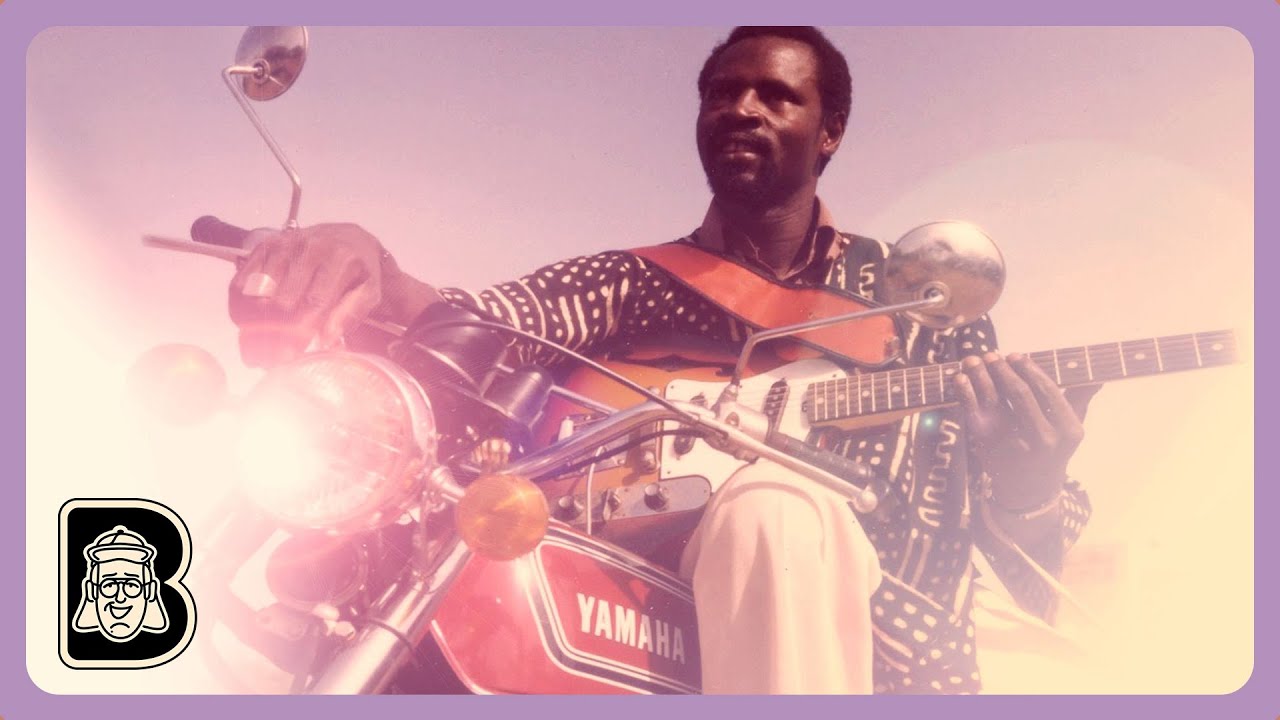
While the American Delta had Bukka White, the banks of the Niger River in Mali had Ali Farka Touré. Often called the “African John Lee Hooker,” Touré was a pioneer who bridged the gap between traditional West African music and the American blues.
As noted in the featured video by Bandsplaining, when Western journalists would ask Ali how he learned to play “the blues,” his famous response was: “To me, blues is a type of soap powder. My music is older than the blues.“ He believed—and musicologists largely agree—that the DNA of the blues (the call-and-response, the scales, the rhythmic cycles) originated in the Sahel and Sahara regions centuries before it reached the Mississippi Delta.
A Noble Rebellion
Born in 1939 (or 1946, accounts vary) in the Timbuktu region of Mali, Ali was the only survivor of ten siblings. Despite being from a “noble” caste where playing music was socially forbidden—a duty reserved for the Griot class—Ali was possessed by the spirit of the guitar. He built his first one-stringed instrument in secret and later transitioned to the acoustic and electric guitar, teaching himself to play in a way that mimicked the traditional sounds of the n’goni and the kora.
The “Hammer and Anvil” of the Sahara
Ali’s guitar style is hypnotically rhythmic. Unlike the aggressive “hammer-on-anvil” thumping of Bukka White, Ali’s playing is characterized by:
- Hypnotic Fingerpicking: He utilized intricate, interwoven riffs that created a “looping” effect, predating the idea of electronic loops by decades [08:24].
- Pensive Spacing: His music evokes the vastness of the Saharan landscape—slow, spiritual, and pensive [08:35].
- Multi-Instrumental Illusion: When playing solo, it often sounds as if two or three guitarists are playing at once, a testament to his independence of thumb and fingers [11:05].
Global Collaborations
Though rooted in his hometown of Niafunké, Ali became a global icon through several high-profile collaborations:
- Ry Cooder: Their 1994 album Talking Timbuktu is a masterpiece of world music, winning a Grammy and bringing Ali’s “Desert Blues” to a mainstream Western audience [10:48].
- Toumani Diabaté: Toward the end of his life, Ali collaborated with the kora master Toumani Diabaté, stripping the music back to its most traditional African roots.
- The Influence on Modern Rock: His legacy paved the way for modern “Desert Rock” bands like Tinariwen, who took Ali’s hypnotic guitar templates and added distorted electric energy [12:30].
The Mayor of Niafunké
Perhaps the most remarkable thing about Ali Farka Touré was his devotion to his land. Despite international fame and two Grammy awards, he refused to live the “rockstar” life in Europe or America. He stayed in Mali, eventually becoming the Mayor of Niafunké. He used his music royalties to fund local infrastructure, water pumps, and agriculture [11:33].
“He was a national symbol. He didn’t just play for Mali; he was Mali.” [12:14]