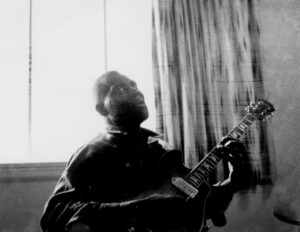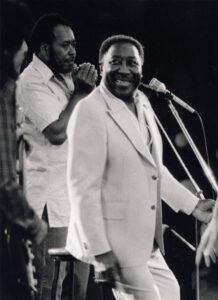
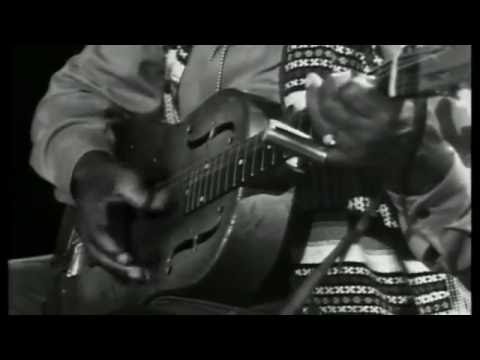
Bukka White (born Booker T. Washington White) wasn’t just a bluesman; he was a percussive force of nature. While many of his contemporaries in the Mississippi Delta focused on intricate fingerstyle melodies, White treated the guitar like a drum set with strings. His music is defined by a relentless, driving rhythm and a vocal “holler” that felt like it was being pulled from the very earth of the South.
Known for his heavy-handed slide work and his National steel resonator guitar, White’s career saw two distinct lives: his initial recordings in the 1930s and his “rediscovery” during the folk revival of the 1960s.
Masterclass in Steel: Guitar Technique
White’s playing style is often described as “hammer-on-anvil.” He almost exclusively used Open G tuning ($D-G-D-G-B-D$) and played with a heavy slide, usually on his pinky, while using his thumb to maintain a “thumping” bass line.
In “Aberdeen Mississippi Blues,” White delivers a masterclass in rhythmic “vamping.” Rather than focusing on complex chord progressions, he relies on a heavy, driving thumb-beat to mimic the steady pace of a train or a long walk. Over this relentless foundation, his slide work acts as a melodic counterpoint, often mimicking the cadences of the human voice. The brilliance of the track lies in its sheer momentum; it is a percussive conversation between the thumb and the steel.
“Fixin’ To Die Blues,” perhaps his most haunting and famous work, centres on a repetitive, jagged riff. His technique here is visceral, involving an aggressive, snapping attack on the strings that makes the guitar sound almost desperate. By using the slide to reach “microtonal” moans which are notes that live in the cracks between standard frets—he heightens the emotional weight of the song’s grim subject matter, effectively sonifying the experience of facing one’s own mortality.
Finally, “Special Stream Line” serves as an incredible exhibition of White’s ability to turn the guitar into a machine. To recreate the sound of a steam locomotive accelerating, he employs a combination of “dead-string” muting and rapid-fire slides. The track is played with blistering speed and intensity, often incorporating a percussive slapping of the guitar body. It is less a song in the traditional sense and more an industrial soundscape played on six strings.
Collaborations and Connections
While Bukka White was primarily a solo performer—his style was so idiosyncratic that it was hard for others to keep up—his influence and professional circles included some of the greatest names in blues history.
B.B. King: Perhaps his most famous “collaboration” was family-based. Bukka was B.B. King’s cousin. When a young B.B. arrived in Memphis, he stayed with Bukka, who taught him the fundamentals of the blues and how to carry himself as a performer. Though their styles diverged wildly, the foundation of B.B.’s soulfulness started with Bukka.
Big Bill Broonzy: During his early recording sessions in Chicago, White crossed paths and performed within the same circles as Broonzy, who was the king of the Chicago blues scene at the time.
The 1960s Revival: After being “found” by John Fahey and Ed Denson in 1963, White shared stages with a new generation of guitarists. He performed alongside Mississippi John Hurt and Skip James at major festivals like Newport. His raw, metallic sound provided a stark, powerful contrast to Hurt’s gentle fingerpicking.
Furry Lewis: In his later years in Memphis, White was frequently paired with Furry Lewis. The two were the “elder statesmen” of the Memphis blues, often appearing together in documentaries and local performances, representing the bridge between the 1920s Delta and the modern era.
“Bukka White didn’t just play the blues; he survived them. His guitar wasn’t an accompaniment—it was a witness.”