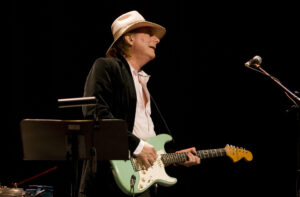

Looking back at the sixties as a time when metal came out of the mountains, Brendan Bayliss represents the era where the walls between genres finally crumbled into the valley. As the founder and primary guitarist for Umphrey’s McGee, Bayliss has spent over two decades proving that “jam band” doesn’t have to mean aimless noodling. Instead, he treats the guitar like a high-precision tool, blending the progressive complexity of King Crimson with the soulful hooks of the Beatles. He is the master of the “controlled chaos,” a player who can pivot from a delicate acoustic ballad to a dual-lead heavy metal assault without ever losing his place in the pocket.
Signature Style: Precision Syncopation and Melodic Counterpoint
Brendan Bayliss’s style is defined by its architectural complexity. While many of his peers in the improvisation scene rely on blues-based pentatonic scales, Bayliss leans into a more “mathematical” approach. He is a master of alternate picking and intricate, palm-muted rhythmic lines that lock in with the drums to create a massive, mechanical groove. His playing is often characterized by “linear” melodies—long, flowing lines that weave through complex chord changes with surgical precision.
What truly sets him apart, however, is his role in a two-guitar attack. Alongside Jake Cinninger, Bayliss provides the melodic “glue.” He often plays the counter-melody or the rhythmic foundation that allows for Cinninger’s pyrotechnics, but when it’s his turn to lead, he favors a “singable” style. His solos are built on tension and release, often utilizing chromatic passing tones to add a touch of jazzy sophistication to a rock-heavy sound.
Top 3 Song Showcases
1. “In the Kitchen”
This is the quintessential Brendan Bayliss showcase. It starts with a clean, infectious rhythmic riff that highlights his “funk-lite” sensibilities. The song evolves through various movements, requiring Bayliss to shift from tight rhythm playing to soaring, melodic leads. It demonstrates his ability to hold a groove for ten minutes while constantly evolving the texture.
For a guitarist, “In the Kitchen” is a study in dynamics. Bayliss shows how to use a volume pedal and pick attack to guide the energy of a room. His soloing here isn’t about speed; it’s about building a narrative that reaches a fever pitch alongside the rest of the band. It’s a masterclass in staying “present” during an extended improvisation.
2. “Hajimemashite”
A fan favorite and a staple of the Umphrey’s catalog, this track showcases Bayliss’s more emotive, classic-rock side. The main theme is a soaring, anthemic melody that highlights his ability to write hooks that stick. It’s a testament to his belief that even in a band known for 20-minute instrumentals, the song remains king.
Technically, this song is about sustain and vibrato. Bayliss uses a creamy, overdriven tone to make the guitar “sing” like a vocalist. For players, it’s an exercise in phrasing—learning when to let a note breathe and how to use wide, slow vibrato to add emotional weight to a simple melody.
3. “Bridgeless”
If you want to see the “mountain-metal” influence in Brendan’s playing, “Bridgeless” is the track. It is a high-octane, progressive metal workout featuring lightning-fast synchronized runs and heavy, chugging rhythms. It highlights the incredible technical chemistry between Bayliss and Cinninger.
For a guitarist, “Bridgeless” is a technical gauntlet. It requires high-speed alternate picking and perfect synchronization with a second guitarist. Bayliss provides the low-end “chunk” during the verses and joins in for the dizzying, harmonized lead lines that define the song’s peak. It proves that despite his melodic roots, he can hang with the best of the shredders.
The Gear: The Paul Reed Smith (PRS) and the Mesa/Boogie
For most of his career, Brendan Bayliss has been a PRS (Paul Reed Smith) loyalist. He typically plays a PRS McCarty or a Custom 24, instruments known for their versatility and ability to handle both crystalline cleans and thick, high-gain distortion. His tone is powered by Mesa/Boogie amplifiers (specifically the Lonestar or Dual Rectifier series), which provide the “American” midrange punch that defines his sound. His pedalboard is a sprawling landscape of delays, filters, and a signature Morley Wah, allowing him to manipulate his tone in real-time during jams.
Conclusion: The Songwriter in the Jam
Brendan Bayliss is the anchor of Umphrey’s McGee. He is the reminder that no matter how far a band travels into the outer reaches of improvisation, they need a foundation of solid songwriting and rhythmic precision to find their way home. He proved that you can be a “guitar hero” while still being a team player, using his instrument to build complex, polyphonic structures that defy easy categorization. You can explore his full session history and live credits via AllMusic
or dive into the band’s massive archives at Umphrey’s McGee Official..