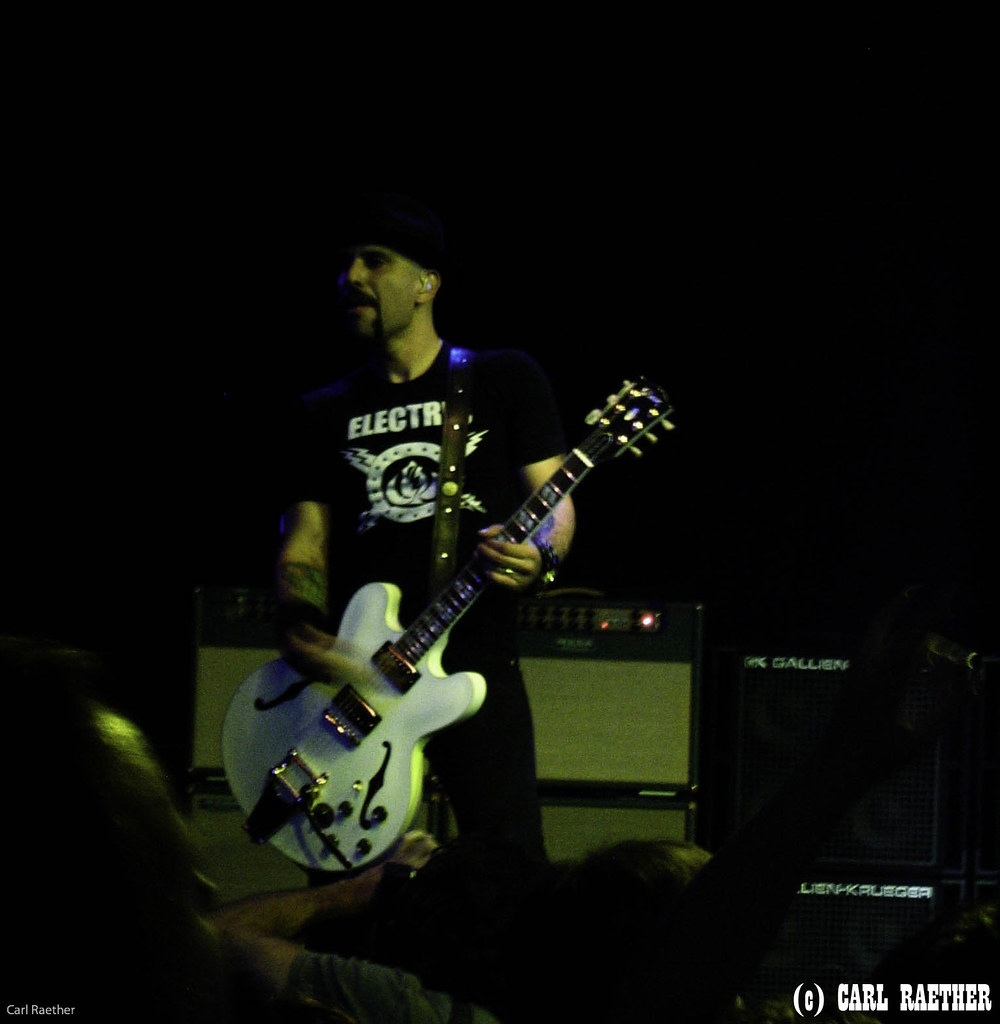
Dave Kushner is one of the most respected “architects of the background” in modern rock. While he has spent his career playing alongside some of the most flamboyant personalities in music history—most notably as the rhythm guitarist for the multi-platinum supergroup Velvet Revolver—Kushner’s value lies in his ability to provide the structural integrity and sonic textures that allow lead players to shine. A veteran of the Los Angeles scene, his journey through bands like Wasted Youth, Electric Love Hogs, and Jane’s Addiction (during their 2001-2002 period) prepared him to be the essential bridge between the punk-metal underground and stadium rock. You can explore his extensive session history and professional timeline via his Dave Kushner Official Gear & Credits.
Signature Style: Textural Depth and Rhythmic Precision
Dave Kushner’s style is defined by a “less is more” philosophy that prioritizes tone and timing over flash. In a band like Velvet Revolver, where he played opposite the iconic Slash, Kushner’s role was to provide a thick, unwavering wall of sound that anchored the songs. He is a master of “The Big Chug,” using a heavy right hand to deliver percussive, palm-muted rhythms that have a mechanical, industrial precision.
However, Kushner is also an avid experimenter with effects. He often uses delays, filters, and choruses to create eerie, atmospheric soundscapes that sit behind the main riffs. This “textural” approach gives his playing a cinematic quality, which eventually led him to a successful career in television scoring, most notably co-writing the theme for Sons of Anarchy. His ability to blend aggressive, punk-influenced power chords with subtle, trippy “ear candy” makes him one of the most versatile rhythm players in the genre, a role detailed in Velvet Revolver’s Dave Kushner: The Art of the Supergroup.
Top 3 Song Showcases
1. “Slither”
“Slither” is the definitive showcase for how Kushner and Slash functioned as a unit. While the main riff is legendary, it is Kushner’s rock-solid rhythm playing that gives the song its relentless, driving momentum. During the verses, Kushner provides the low-end grit that allows the bass and lead guitar to dance around the melody. He uses a high-gain, mid-heavy tone that fills the gaps in the frequency range, ensuring that the song never loses its “heavy” feel even when Slash moves into higher registers for his accents.
For a guitarist, “Slither” is a study in “The Pocket.” Kushner’s timing is metronomic, locking in perfectly with Matt Sorum’s drums to create a unified rhythmic front. He doesn’t overplay; he understands that the song’s power comes from the repetition and the “swing” of the riff. By holding down the fort during the more chaotic sections of the track, he allows the song to remain a cohesive, radio-ready hit despite its aggressive roots. It is a masterclass in how a rhythm guitarist can be the “engine” of a massive rock anthem.
2. “Sucker Train Blues”
On “Sucker Train Blues,” Kushner’s punk rock roots are on full display. The track is a high-speed, technical exercise in down-picking and rapid-fire chord changes. Here, Kushner’s role is more about sheer physical energy. He provides a blistering, distorted backdrop that recalls the frantic pace of the LA hardcore scene where he started his career. The song requires incredible wrist stamina and precision to keep the “chug” clean at such high tempos.
What makes his performance on this track stand out is the clarity of his chords despite the high levels of saturation. Kushner has a knack for finding voicings that cut through the mix without becoming muddy. During the bridge, he incorporates more atmospheric, ringing notes that provide a brief moment of “space” before diving back into the high-octane main theme. It’s a perfect example of his “sonic glue” technique—keeping the energy at a breaking point while ensuring the musical structure remains intact.
3. “Gravedancer”
While Velvet Revolver was largely defined by its high-octane sleaze rock, “Gravedancer” is the track that reveals the true depth of Dave Kushner’s sonic palette. On this mid-tempo, atmospheric piece, Kushner moves away from the “chug” and focuses on creating a lush, swirling landscape. He utilises subtle delays and modulation to create a sense of space that feels both haunting and expansive. It is here that his “textural” approach is most effective, providing a shimmering backdrop that allows the vocals to sit in a bed of ethereal guitar noise.
For a guitarist, “Gravedancer” is a study in the “ambient” side of hard rock. Kushner uses the guitar to build a mood rather than just a riff, employing long, ringing chords and volume swells that give the track a cinematic quality. This particular style of playing—where the guitar functions more like a keyboard or a synthesizer—became a precursor to his later success in television scoring. He demonstrates that in a two-guitar band, the second guitarist doesn’t always have to double the rhythm; they can act as the “atmosphere,” providing the emotional weight and tonal colour that turns a standard rock song into an immersive experience.
The Gear: Fernandes Ravelles and the “Dirty” Tone
For much of his career, Dave Kushner was synonymous with the Fernandes Ravelle. With its unique, offset body that looks like a cross between a Les Paul and a Mockingbird, the Ravelle provided Kushner with a distinct visual and sonic identity. He famously utilized the Fernandes Sustainer system to achieve the long, infinite drones heard in his more atmospheric work. His amplification usually involves a blend of Bogner and Marshall heads, giving him a “chewy,” mid-range distortion that sits perfectly in a two-guitar mix. Details on his specific model can be found at Fernandes Guitars: The Dave Kushner Ravelle Signature Series.
Watch Dave Break it Down
Watch Dave himself break down the techniques behind “Slither” in this rare guitar tutorial. This video is highly relevant because Dave Kushner personally explains and demonstrates how to play the rhythm parts for one of Velvet Revolver’s most iconic songs, giving you a direct look at his “piston-like” technique.
Conclusion: The Unsung Hero of the Fretboard
Dave Kushner remains one of the most important “glue” players in rock history. He proved that you could be in a band with some of the most famous musicians on earth and still be an essential, irreplaceable part of the sound. By mastering the balance between rhythmic aggression and sonic experimentation, he created a blueprint for the modern rhythm guitarist. Kushner isn’t just the guy standing next to the lead singer; he is the architect who built the stage they stand on.