
Welcome back to Guitardoor.com, where we pay tribute to the foundational pillars of the guitar—the players whose influence is so profound, it feels like it’s in the instrument’s very DNA. Today, we celebrate one of the most important, revered, and inspirational figures in music history: the one and only Django Reinhardt. The first true jazz guitar virtuoso to emerge from Europe, Django was a brilliant Romani-French musician who not only created a new genre of music but did so after overcoming a devastating injury that should have ended his career, cementing his legacy as a true giant of the 20th century.
The Birth of Gypsy Jazz
The musical style of Django Reinhardt, now known as “Gypsy Jazz” or “Jazz Manouche,” was a sound born from the vibrant and diverse cultural melting pot of 1930s Paris. With his legendary group, the Quintette du Hot Club de France, featuring the brilliant violinist Stéphane Grappelli, Django fused the swinging, improvisational spirit of American jazz masters like Louis Armstrong with the fiery, melancholic passion of his own Romani folk traditions and the elegance of French musette waltzes.
The Quintette was unique in that it featured no drummer. The rhythm was driven by the percussive, acoustic rhythm guitars—a technique known as “la pompe”—and a string bass, creating a light, swinging, and incredibly propulsive sound. This all-acoustic format was the perfect backdrop for Django’s guitar, which he elevated from a rhythm instrument to a premier solo voice, on par with any saxophone or trumpet of the era. He was the first truly original and influential European voice in jazz.
Anatomy of a Miracle: Technique and Tone
The story of Django Reinhardt’s technique is one of the most incredible tales of perseverance in music history. At the age of 18, he was caught in a caravan fire that severely burned the left side of his body. His fretting hand was horrifically injured, with his fourth (ring) and fifth (pinky) fingers being permanently fused and curled towards his palm. Doctors told him he would never play the guitar again.
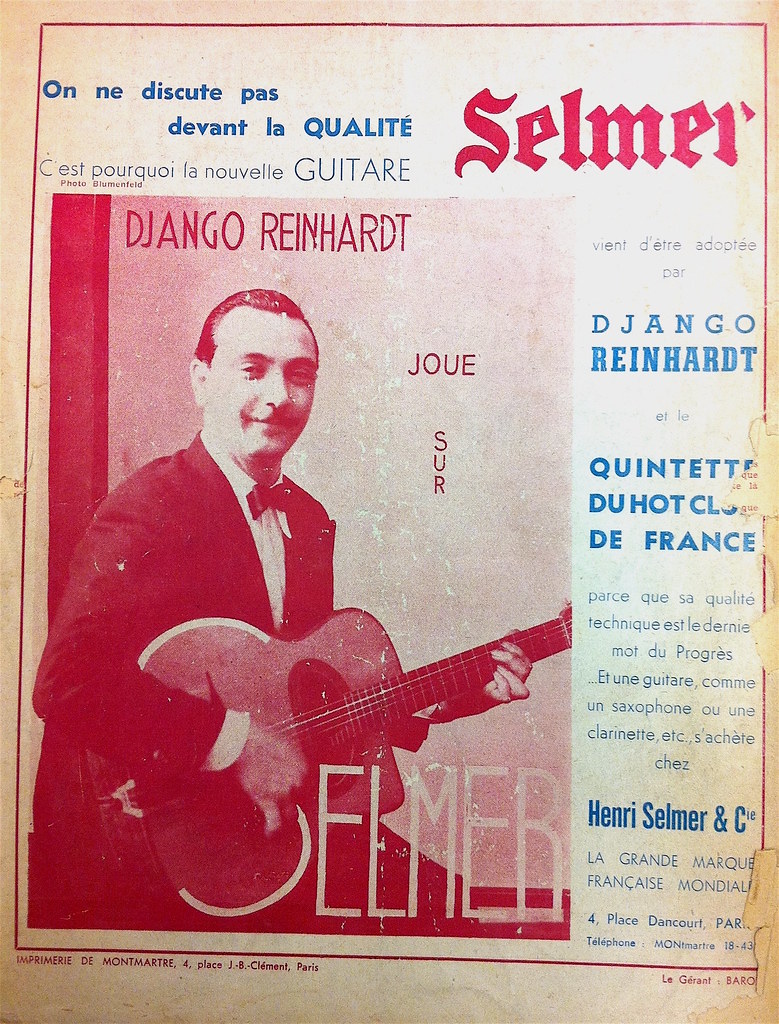
Refusing to accept this fate, Django painstakingly reinvented the instrument for himself. He developed a revolutionary new system of playing where he used only his two “good” fingers—his index and middle—for all of his astonishingly fast and complex single-note solos, arpeggios, and melodic runs. He was able to use his injured fingers to fret certain chord shapes on the lower strings, but his lead playing was a “two-fingered” miracle. This profound limitation forced him to create a completely new and unique vocabulary for the guitar, full of incredible stretches, slides, and arpeggiated patterns that remain a benchmark for virtuosity.
His instrument of choice was as unique as his playing. He is famously associated with the Selmer-Maccaferri acoustic guitar. This instrument, with its distinctive “D-shaped” or oval soundhole and internal resonator, was designed to be incredibly loud and cutting. It was the perfect tool for Django to be heard as a lead instrument in an all-acoustic setting, long before reliable amplification was common. The bright, punchy, and percussive tone of this guitar is the definitive sound of Gypsy Jazz.
Essential Django: The Hot Club Canon
Django Reinhardt’s recordings from the 1930s and ’40s are foundational texts for all of jazz guitar. To understand his revolutionary style and his incredible spirit, these three tracks are absolutely essential.
“Minor Swing”
“Nuages”
“Limehouse Blues”
Django Reinhardt was a true giant of the guitar, a figure whose importance and influence rank alongside legends like Robert Johnson and Charlie Christian. He was a musical genius who not only created a new genre but did so by overcoming a seemingly insurmountable obstacle with sheer force of will. His music is a timeless celebration of life, passion, and the unbreakable power of the human spirit, and it continues to inspire a dedicated global community of musicians who keep the flame of Gypsy Jazz burning brightly.
Cover Photo Credit “Django Reinhardt” by d’jeanof is licensed under CC BY-NC-SA 2.0