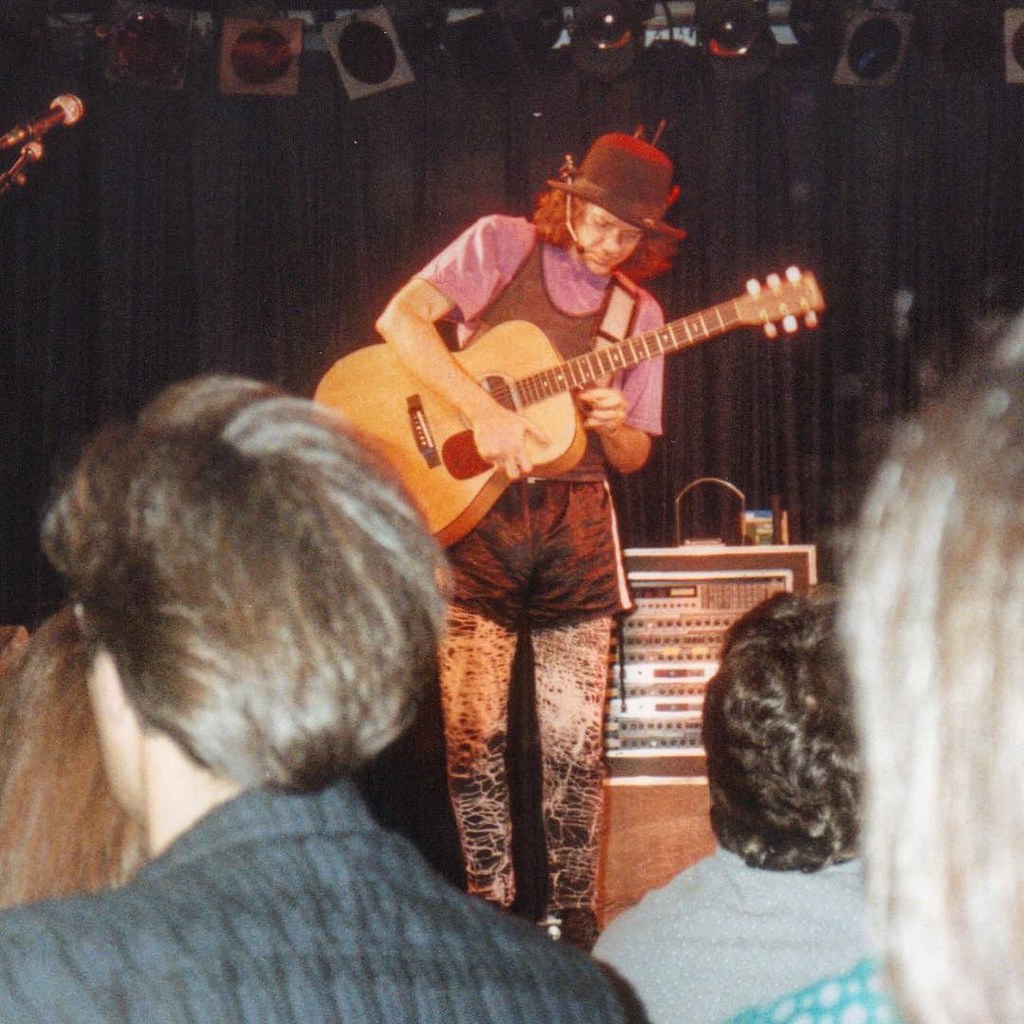
Welcome back to Guitardoor.com, where we celebrate the true visionaries who have expanded our understanding of what the guitar can do. Today, we explore the sonic universe of a player who wasn’t just a guitarist, but a composer, an inventor, and a force of nature who completely redefined the acoustic guitar: the one-of-a-kind Michael Hedges. A graduate of the prestigious Peabody Conservatory, Hedges approached the steel-string guitar not as a folk instrument for strumming chords, but as a limitless orchestra, capable of melody, harmony, bass, and percussion all at once. His influence is so profound that the entire modern fingerstyle movement exists in his shadow.
The Acoustic Orchestra
Michael Hedges famously described his own music with playful yet accurate terms like “Acoustic Thrash,” “Heavy Mental,” and “Deep-Tissue-Folk.” These labels capture the intense, high-energy, and deeply complex nature of his compositions. His music was a genre unto itself, drawing from a vast palette of influences including classical minimalism, folk melodies, hard rock energy, and avant-garde experimentation. He treated the guitar as a grand compositional tool, and his songs were intricate, dynamic soundscapes that were breathtaking in their complexity and emotional in their delivery.
His formal training as a composer was evident in everything he played. He wasn’t just stringing together impressive licks; he was creating structured, sophisticated pieces of music. He was a pioneer who saw the guitar not for what it was, but for what it could be. He saw the fretboard as a keyboard, the strings as a harp, and the wooden body as a drum. By combining these elements, he was able to create a sound so full and multi-layered that it often sounded like several musicians playing at once.
Deconstructing the Guitar: Technique and Tone
To understand Michael Hedges’ music is to understand his revolutionary and highly unorthodox techniques. He approached the instrument from a completely fresh perspective, inventing a new vocabulary for the acoustic guitar.
Two-Handed Tapping: Perhaps his most stunning innovation was his extensive use of a two-handed, contrapuntal tapping technique. He would use the fingers of both his left and right hands to tap notes directly onto the fretboard, much like a pianist plays a keyboard. This allowed him to play independent bass lines, melodies, and harmonies simultaneously, creating intricate musical conversations that were previously thought impossible on a single guitar.
Percussive Elements: Hedges was a pioneer in using the entire guitar as a percussion instrument. He perfected a technique now known as “slap harmonics,” where he would slap a string over a harmonic node on the fretboard with his right hand to create a sharp, bell-like percussive tone. He would also use the palm of his hand to strike the guitar’s body to create deep, resonant kick drum sounds and use his fingers to tap out snare-like rhythms, all while playing melodic parts.
Alternate Tunings: Central to his entire musical universe was his mastery of alternate tunings. He very rarely played in standard E-A-D-G-B-E tuning. Instead, he crafted unique, custom tunings for nearly every composition. These tunings were integral to his songwriting process, opening up new harmonic possibilities, creating beautiful open-string drones, and making his signature techniques physically possible.
His gear was also a crucial part of his sound. He famously played a 1971 Martin D-28 he nicknamed “Barbara,” which he customized heavily. To capture the full sonic range of his playing—from the subtlest string nuance to the loudest percussive body slap—he utilized a complex stereo pickup system, often blending a magnetic pickup in the soundhole with a contact transducer pickup mounted inside the guitar’s body. This signal was then sent through a rack of effects, including reverb and delay, to create his famously lush and atmospheric live sound.
Essential Hedges: A Journey into New Sonic Territory
Michael Hedges’ discography is a gateway to a whole new way of thinking about the acoustic guitar. To witness his genius, these three landmark tracks are the essential starting point.
“Aerial Boundaries”
This is arguably Hedges’ most famous composition and the title track of his 1984 masterpiece. “Aerial Boundaries” is a shimmering, expansive soundscape that uses a unique tuning (C-C-D-G-A-D) to create a harp-like resonance. It features intricate slap harmonics and a driving, rhythmic pulse that redefined the “new age” genre by injecting it with raw technical prowess. The track remains a benchmark for every fingerstyle player today.
“Ragamuffin”
Representing the “Acoustic Thrash” side of his personality, “Ragamuffin” is a high-energy, percussive tour-de-force. It showcases his incredible right-hand precision and his ability to maintain a rock-and-roll intensity on an acoustic instrument. The song is characterized by rapid-fire tapping and aggressive rhythmic stabs, proving that the acoustic guitar can be just as “heavy” as its electric counterpart.
“Because It’s There”
A beautiful example of his cinematic and atmospheric work, “Because It’s There” was originally written for a documentary about explorer Naomi Uemura. Performed on his famous 1920s Dyer Symphony harp guitar, the piece uses the sub-bass strings to create a vast, orchestral foundation. It’s a haunting, evocative track that captures the feeling of a journey across a frozen tundra.
Michael Hedges was a true visionary whose tragic and untimely death left a profound void in the music world. He was the acoustic guitar’s Jimi Hendrix—an innovator who completely shattered pre-conceived notions and created a new path for all who followed. Every modern fingerstyle guitarist who uses tapping, percussion, and alternate tunings owes a direct and significant debt to the beautiful, complex, and revolutionary music of Michael Hedges.
Cover Photo Credit”I found a photo of Michael Hedges I took from the early 90s. Today would have been his birthday. He was such an amazingly talented musician.” by futileboy is licensed under CC BY-NC 2.0